

Sweet and salty, this toast is perfect for brunch or dessert! And caramelizing bananas is easier than you might think. This recipe includes proportions for 2 toasts.
The Recipe
Prep time: 3-5 mins
Cook time: 20 mins
Start-to-finish time: ~25 mins
Complexity: 4/10 (multiple cooked components, caramelized bananas are fragile once cooked)
Budget: Using the proportions and ingredients below, this recipe costs approximately $7.50 in total (~$3.25 per toast). You could reduce the cost of this toast by using non-gluten-free bread.
Occasion: This toast is excellent for a sweet brunch or for a dessert (especially if you cut off the crusts). This combination of toppings would also be delicious on a pancake, waffle, or french toast.
The Ingredients
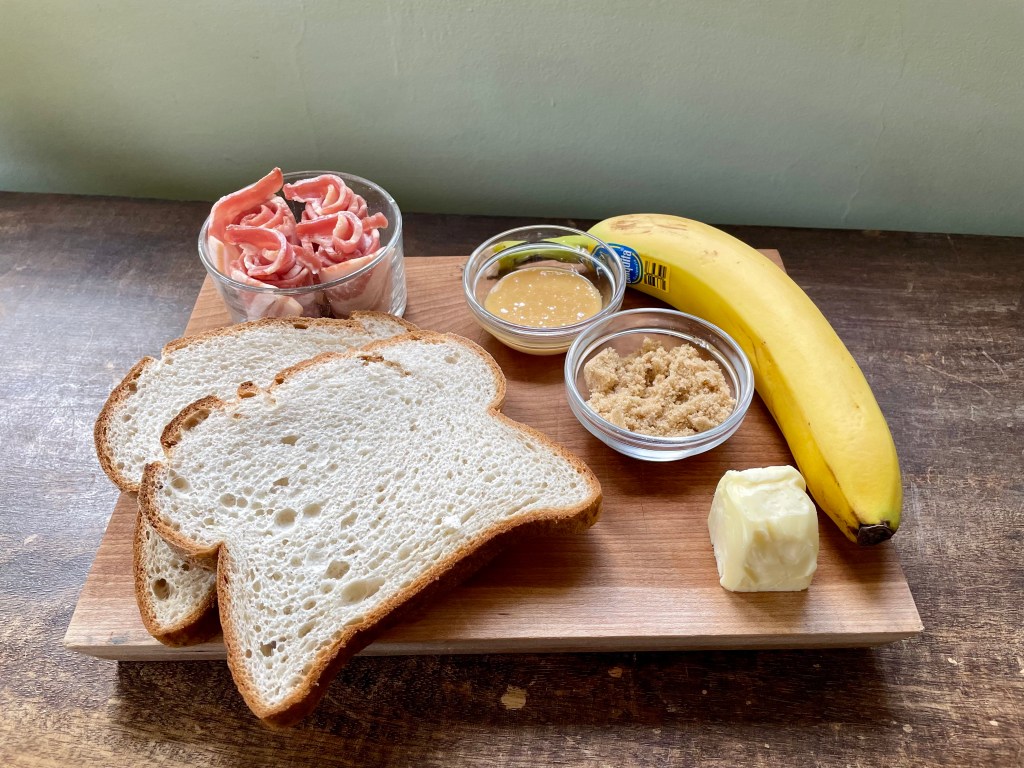
- One large banana (not overripe, or it will be too mushy to caramelize properly—slightly green is best)
- 2 tbsp butter
- 2 tbsp brown sugar
- Bacon (~2 slices per piece of toast: 1 ½ pieces for the base, ½ of a piece for garnish)
- 2-4 tbsp maple butter, plus an extra 1-2 tsp for drizzling
- 2 slices of bread, for toasting (white, ciabatta, or brioche would all be good for this recipe)
- A pinch of salt
- Optional: ground cinnamon
The Steps
- Melt the butter in a medium-sized frying pan over medium heat
- Peel the banana and cut it into several slices, about 1.5 cm thick
- Cook the bacon until crispy (we’re going for bacon-bit-doneness)
- You can do this in a frying pan, the oven, or in the microwave. I prefer the microwave because it’s quick, doesn’t splatter grease everywhere, and saves on dishes.
- For cooking in a pan: start by laying the bacon strips flat in a cold frying pan and turn on the burner to medium heat. Flip the bacon every couple of minutes until the desired crispiness is reached.
- For cooking in the microwave: stack 3-4 layers of paper towel sheets on a large, microwave-safe plate. Lay out the bacon strips on the paper towel and cover with 2-3 more sheets of paper towel. Cook on high for approximately 1 minute per slice of bacon on the plate (if you have 5 slices, cook for 5 minutes). Check to make sure the bacon is cooked through and crispy enough. If it needs more time, microwave in additional 1-minute intervals until desired crispiness is reached.
- Either Bounty or Kirkland are the best paper towel brands for this—brands with thinner or less sturdy sheets will stick to the bacon while it’s cooking, which will make it unusable. This is also the case for most eco-friendly brands of paper towel.
- For cooking in the oven: Line a baking tray with tinfoil. Lay out your bacon strips side-by-side without overcrowding the pan. Place into a cold oven. Turn on the oven to 400ºF and bake the strips for about 20 minutes (this is slightly longer because the bacon cooks as the oven pre-heats—if you put the bacon into a hot oven, reduce the cooking time). Remove the pan from the oven and put the cooked bacon slices on some paper towel to remove excess grease.
- While the bacon is cooking, add the sliced bananas, brown sugar, and salt to the melted butter in the pan. Stir together until syrupy and bubbling.
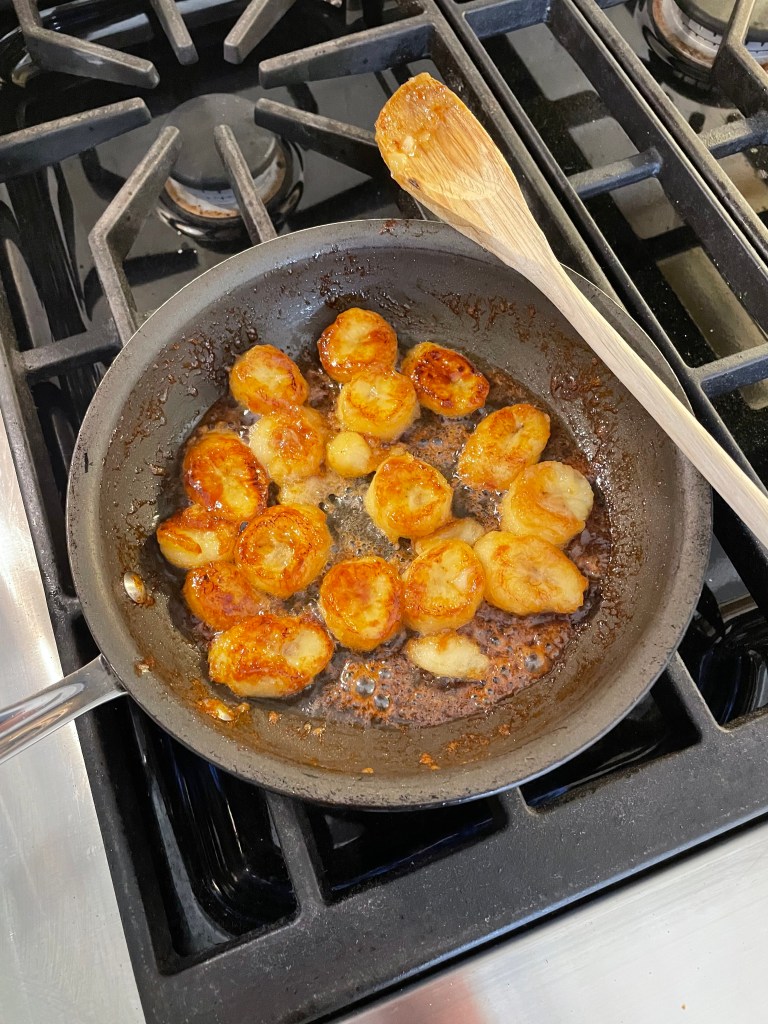
- Arrange the banana slices in a single layer in the bottom of the pan. Let the bananas cook in the butter and sugar until golden brown on the bottom (4-5 mins). Then, flip them over one-by-one and cook for another 4-5 minutes.
- While the bananas are cooking, begin toasting your bread.
- While the bread is toasting, cut the crispy cooked bacon into small bits. Reserve one slice worth of bacon bits for sprinkling on top at the end.
- When the toast is finished, spread the maple butter (2-4 tbsp) on top. Then, add most of the bacon bits and top them with a layer of the caramelized bananas.
- I strongly recommend that you don’t add more than ½ of a banana’s worth of slices per toast, otherwise the banana will overpower the other flavours.
- To finish, top the toast with the rest of the bacon bits and drizzle with more maple butter. For more of a bananas foster vibe, sprinkle some ground cinnamon overtop.
- A tiny sprinkle of extra salt on top of the toast helps tie everything together (sounds weird, but trust me).
- Enjoy!!
The Extras
Here’s how those gorgeous bananas should look once they’re caramelized:
Simplify it
The Bacon:
- Instead of chopping up your cooked bacon into bits, leave the strips whole. For the garnish, break the remaining amount of bacon into larger chunks (when the bacon is crispy enough, it should just snap).
- Alternatively, swap out the bacon for smoked ham deli meat and fry it up a little bit before putting it on the toast.
- Even simpler: swap out real bacon for pre-made bacon bits (real or faux). This will greatly reduce the cost and time involved in this recipe (but in my opinion, nothing beats the flavour of home-made bacon).
The Bananas:
- Ultra simple: skip the caramelization and add raw banana slices to your toast.
- Faster (but requires specific equipment): Lay the banana slices on a baking tray. Sprinkle the brown sugar on top of the banana slices and brulée them with a torch. Flip, and repeat. To include cinnamon in this, mix the brown sugar and cinnamon together before you sprinkle it on the bananas.
- Less hands-on: Turn on your oven to broil. Lay the banana slices on a parchment-lined baking sheet in a single layer. Grate the butter and mix it with the brown sugar (and optionally the cinnamon). Sprinkle the banana slices with the brown sugar/butter mixture and broil until golden brown. Be sure to watch the banana slices carefully so they don’t burn!
Scale it up
The Bacon: Upgrade your bacon by buying thick-cut and/or maple-glazed bacon strips. Alternatively, try swapping out the strips altogether for Canadian back bacon, slices of roasted ham, or a different salty cured pork product, like prosciutto or speck.
The Base: Instead of just using regular toasted bread, try putting this combination of toppings atop French toast! Don’t skip the cinnamon sprinkle at the end if you opt for this one.
The Bananas: Turn the bananas into bananas foster by adding a little bit of rum and cinnamon to the pan while you cook them.
About the Ingredients
Maple Butter
Also known as Maple Cream, this is a is a whipped spread made entirely of maple syrup. Despite its name, there’s no butter or any other dairy involved in creating maple butter. To make it, producers first heat maple syrup and then cool it down in a controlled crystallization process. Then, they whip the cooled syrup to incorporate air until it becomes light, fluffy, and spreadable. Invented in 1938, maple butter is the pride of sugar shacks across the province of Quebec. The history of maple butter is intricately tied to the history of maple syrup, which settlers learned about from First Nations peoples in Canada. You can read more about the history of maple syrup here.
Bacon
Fat is flavour! The best bacon has a much higher fat content than meat and it’s the fat that gives bacon its crispy, tender texture. Bacon is typically cured in a combination of salt, sugar, nitrates, and flavourings before being smoked and sliced.
Bacon goes way back…but the iconic strips come from the side of the pig (unless you’re eating Canadian or Irish back bacon—that actually comes from the back). While the Ancient Romans are said to have cooked with bacon fat, the earliest recorded preparation of pork that resembles the bacon we know today comes from China. Around 1500 BCE, people in China would cure pork meat by rubbing it with salt. The curing process allowed the pork to last for a long time without requiring refrigeration, making it easy to store and travel with. But this was done with many different cuts of pork meat, so it’s more the curing process than the end product that ties it to our modern bacon.
The bacon we see in grocery stores today was a British invention. In pre-industrial Britain, it was pretty normal for families to have pigs in their backyards and even their basements for pork production. Each family would have their own unique curing recipe for the bacon, creating neighbourhood-scale regional varieties across Britain. It wasn’t until the 1930s that keeping a pig in your basement was outlawed there for health and safety reasons.
Bananas
These bright yellow fruits are the perfect portable package, packed with potassium, magnesium, vitamin B6, and fibre. Also, their cultivation has a huge economic and political history that’s tarnished by discrimination, exploitation, plantations, and economic trouble (think: banana republics), in which the United Fruit Company (now Chiquita) was heavily involved. There are lots of great sources out there on its political and economic history, and this article and this video are good starting points for learning more about the fruit’s social/economic/political history.
Scientists and food historians speculate that the banana could be one of the the world’s first fruits, at about 10 000 years old. Although, according to this source, figs, pears, pomegranates, and grapes are older, and dates are even older still. Regardless of where it falls in the fruit timeline, the banana (which is technically also a berry) and its biological history remain super interesting.
Bananas are native to South and Southeast Asia, especially the areas of the Malaya Peninsula, Indonesia, the Philippines, and New Guinea. However, wild bananas look hardly anything like the grocery store bananas we know today—they were (and are) smaller and had large, inedible seeds in the middle (much less banana-y goodness). A cultivated version of the banana that’s closer to our modern fruit was supposedly developed in Africa in about 650 CE. This was the result of cross-breeding two different wild banana varieties: the Musa Acuminata and the Musa Baalbisiana. This crossing greatly reduced (and eventually eliminated!) the seeds, making them much more edible. Modern bananas may contain tiny black seeds, but they’re not fertile (they’re hardly even visible).
There are about a bajillion different cultivars of banana in all different colours and sizes, but when people first began cultivating them, they were classified in two categories: cooking bananas and dessert bananas (think: plantains vs. grocery store bananas). Since the 1960s, the bananas you can buy in the grocery store are genetically identical Cavendish clones. Prior to this, people were still eating a bunch of banana clones, but they were of a different kind: the Gros Michel. The Gros Michel was larger, sweeter, and what emulation banana flavouring tastes like (turns out eating banana-flavoured candy is also tastebud time travel). Since the genetic makeup of the clones lacks diversity (by definition), a single fungicide resistant pathogen called Panama Disease wiped out the entire population of the Gros Michel. Since the Cavendish bananas are also clones, they’re at the same risk of being wiped out by disease. But with our modern understanding of genetics, scientists are working to slow down the spread of disease to keep the Cavendish alive.
Bananas have affected almost everyone on the planet. And to many, they’re beloved. Especially to figures like Ray Comfort and Kirk Cameron, who suggest in the Banana Argument that the structure of the banana is evidence of the existence of God.
Brown Sugar
Brown sugar is made up of sucrose crystals combined with a little bit of molasses, which gives the sugar it’s titular colour. Different concentrations of molasses lend the sugar different colours and flavour profiles (more molasses = dark brown sugar; less molasses = light brown sugar; medium molasses = golden brown sugar). Contrary to popular (and already debunked) opinion, brown sugar is really not a healthier alternative to white sugar. The inclusion of molasses in brown sugar marginally increases the potassium, iron, and calcium contents of the ingredient, but at the core they’re basically the same in terms of nutrition. Both brown and white sugar originate from the same sugar crops; usually sugarcane or the sugar beet plant.
Despite their nutritional and origin similarities, the two kinds of sugar differ quite a bit in taste, structure, and culinary use. Both kinds of sugar start as molasses and then undergo crystallization, centrifuge, and filtration processes to create sugar crystals and remove the appropriate amount of molasses. Brown sugars have larger crystals and more molasses because they spend much less time in a centrifuge, which spins extremely fast to separate the sugar crystals from the liquid molasses. By contrast, white sugars have smaller crystals and all the molasses removed because they undergo a more intense centrifuge and filtration process. Brown sugar can be either refined or unrefined—the former is refined white sugar with molasses added back to it, and the latter is the less processed version of brown sugar mentioned above.
The two kinds of sugar also have different uses in baking. The molasses in brown sugar tends to retain moisture, so it works well in baked goods that are soft and dense. The lack of molasses and smaller crystals of white sugar help it to be easily incorporated into baked goods and components that have an airy texture, like cakes and whipped cream.
Instead of recapping the history of brown sugar myself here, I’d like to direct you to this awesome essay by Amari Victoria Stokes, who wrote this piece for a Duke University culinary cultures class. She tells the story of brown sugar with incredible detail, nuance, and lots of resources for further reading, if you’re interested!
Butter
The spread of butter across the world was no accident. But its origins apparently are. In her book about butter, pastry chef and food writer Elaine Khosrova tells the story of how a herder in Africa around 8000 BCE was travelling with a container of milk strapped to one of his sheep. After a long journey of being jostled around by the sheep’s gait, the milk fats had solidified into butter.
There’s lots of story to tell here, so below are some recommended links for reading about the extremely interesting and lengthy history of butter. But in the meantime, here are some of the best butter stories I’ve found so far (most of these are sourced from The Butter Journal, which everybody should immediately go read):
Butter has had a huge impact on the economy of Europe throughout history. Butter was so central to the Irish economy at one point that they set up a butter exchange in Cork. There was so much butter to go around that they would make it in barrels and then age the barrel butter by burying it in a bog. Apparently ancient butter barrels are one of the most common archeological finds in Ireland today.
Mediterranean countries preferred to use cooking oils instead of butter, likely because their climates were not conducive to storing butter for long periods of time. European countries that were more to the north like the Scandinavias, however, were very active in the butter business. Apparently, butter was so important in Norway that in the middle ages, the king of the country required a whole barrel each year as a tax.
Butter continues to be the centre of some economic spheres. For example, Canada’s dairy lobby (colloquially known as the dairy cartel or Big Dairy in this Harvard International Review article) spends tens of millions of dollars each year to maintain certain relationships with parliament and strictly controls prices and production. A Calgary Herald Article reports that during Stephen Harper’s time as prime minister, import tariffs on non-domestic dairy products were between 202% (for skim milk) and 298% (for butter).
In France, butter was in such high demand that there was a need for some kind of replacement (manufacturing couldn’t keep up). So, Napoleon III (not the famous Napoleon, one of his nephews) put out a public call for someone to come up with a reasonable substitute. In 1869, scientist Hippolyte Mèges-Mouries came up with the first version of margarine, which he created by churning beef tallow with milk. This product was of course limited by the availability of beef tallow. What we know as margarine today (hydrogenized vegetable oil) was invented by a German scientist Wilhelm Normann in 1902.
Check out these sources if you want to read more about the history of butter:
How Butter was Born and Why it Spread
The Culinary Institute of America
Price Breakdown
Unit price based on the average cost of a single package of each ingredient in Canada:
| Ingredient | Unit Price (CAD) |
| Bacon | $0.72/slice |
| Maple Butter | $0.06/gram |
| Bananas | $0.35/banana |
| Promise Bread | $0.75/slice |
| Butter | $0.02/gram |
| Brown Sugar | $0.04/gram |
Approximate price of each portioned ingredient, based on unit price:
| Portioned Ingredients | Price per portion (CAD, based on unit price in table above) |
| 4 slices of bacon | $2.88 |
| 2 tbsp maple butter | $1.15 |
| 1 banana | $0.35 |
| 2 tbsp butter | $0.56 |
| 2 slices of bread | $1.50 |
| 2 tbsp brown sugar | $1.04 |

 Put it on Toast!
Leave a reply to Maple Butter, Bacon, and Caramelized Banana Toast – Put it on Toast! | My Meals are on Wheels Cancel reply