

The tart and sweet blackberries balance the funky camembert! A nice appetizer, especially during the summer.
The Recipe
Prep time: 5 mins
Cook time: 5 mins (melting the cheese); ~20 mins (blackberry balsamic reduction simmer time)
Start-to-finish time: ~30 mins, if you make the reduction while you’re making the toast, ~10 mins if you have the reduction on hand.
Complexity: 5/10
Budget: The price of this toast will vary depending on where you live and the time of year because of the blackberries—if you’re making the reduction, you’ll want a full pint. Since many of the ingredients in this toast are pantry and fridge staples (bread, corn starch, lemon, honey), the most expensive elements are the cheese, the fresh mint, and the blackberries.
Occassion: This toast is a crowd-pleasing appetizer! Perfect for a dinner party, or to bring to a summer picnic.
The Ingredients
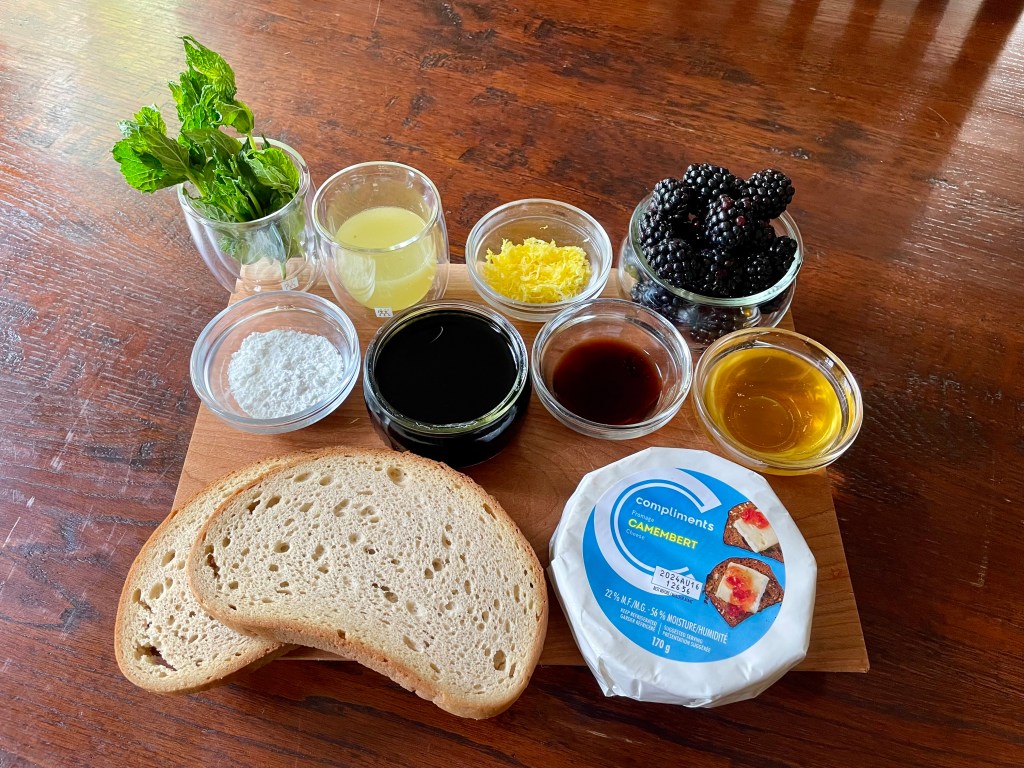
- Camembert cheese, cut into slices (not wedges! we’re going for even melt-age)
- ½ cup of balsamic vinegar
- A pint and a half of blackberries (the full pint for the reduction, the half-pint for topping the toast)
- The juice of half a lemon
- The zest of a full lemon
- Several sprigs of fresh mint
- 2 tablespoons of honey
- 1 tablespoon of vanilla extract
- 2-3 tablespoons of cornstarch (and 2-3 tablespoons of cold water)
- Bread (of course)—this one works well with sourdough! Pictured here is Schär’s rustic sourdough loaf.
- Chopped roasted nuts of your choice (I used almonds; not pictured here)
The Steps
- Make the blackberry balsamic reduction:
- In a small saucepan over medium-low heat, combine:
- 1 cup of balsamic vinegar
- the juice of half a lemon
- the zest of a whole lemon
- one pint of blackberries
- 2 tablespoons of honey
- a few teaspoons of vanilla extract
- A sprig of fresh mint
- Stir these ingredients together and bring the mixture to a simmer
- Turn the heat to low, cover, and let simmer for ~15 minutes. Stir occasionally, and crush/burst the blackberries with a potato masher or spoon once they’re soft.
- Once ready, poor the liquid through a fine mesh strainer into a separate bowl. Remove the sprig of mint from the strainer. Using the back of a spoon, scrape the strainer over top of the bowl to ensure all the blackberry flesh has made it into the reduction.
- Return the strained reduction to the pot.
- Mix 2-3 tablespoons of cornstarch slurry (1:1 tablespoons of cornstarch to water).
- Add one 1tbsp of the slurry to the strained reduction, stir thoroughly, and bring the mixture back to a simmer.
- Repeat this final step until your desired consistency is reached (make more slurry if you want it to be thicker!). My preference is for the reduction to be relatively liquid-y, but coat the back of a spoon, which took me about 3tbsps of slurry.
- In a small saucepan over medium-low heat, combine:
- While the reduction is simmering, cut several relatively thin slices of Camembert cheese. If you prefer, remove the bloomy rind (I like to leave it on for extra depth of flavour).
- Coarsely chop some nuts of your choice (I used roasted unsalted almonds here)
- Lightly pre-toast your bread to ensure it doesn’t get too soft when you melt the cheese overtop of it.
- Once the reduction is ready (and thickened according to your preference), lay the Camembert slices on the lightly toasted bread in a single layer.
- Melt the cheese onto the toast under either a low broil or in a toaster oven.
- Once melted, top the cheese with blackberries, fresh mint leaves, and the coarsely chopped nuts. Drizzle the blackberry balsamic reduction overtop and serve!
- Enjoy!!
The Extras
Simplify it:
The cheese: If you’re not feeling the camembert, you could sub it out for cream cheese or goat cheese. The flavour profile will, of course, vary but it will still be delicious!
The fruit: You could swap out fresh blackberries for frozen fruit of your choice to reduce the cost or change the flavour of the balsamic reduction. Frozen blueberries or haskap would be pretty delicious for this.
The mint: Dried mint would work well in both the reduction and as a garnish!
The glaze: if you don’t have time to make a glaze, you could buy a pre-made one. Nonna Pia’s glaze is a favourite of mine and their Cabernet Merlot glaze would be delicious on this toast.
Scale it up:
The mint: Slice the mint leaves into chiffonade ribbons to make the presentation more delicate and to better spread the mint flavour between each bite.
The nuts: To add an extra bit of sweetness and caramel flavour, consider candying the nuts before you top the toast with them.
About the Ingredients:
JUMP TO:
CAMEMBERT CHEESE | MINT | BALSAMIC VINEGAR | BLACKBERRIES | HONEY | LEMON | CORN STARCH | ALMONDS |
Camembert Cheese
This cheese is legendary. Literally. Here’s the legend: This creamy, bloomy soft rind cheese was first invented in the village of Camembert in the Normandy region. The official regional protected variety is called Camembert de Normandie, which includes milk from heritage herd cows that is fed on nutritious grass that grows year-round thanks to the region’s wet climate. It’s said that the birth of Camembert is tied to the French Revolution: Marie Harel, a dairy farmer in Camembert, sheltered an Abbott and cheese maker from Brie (the place that brie cheese is named after) who was fleeing the revolution. In return for her kindness and his safety, the abbott showed her how to make Brie cheese. She then made small refinements to the process and Camembert was born. Harel passed her cheese-making secrets onto her daughter and the specific Camembert process has remained in the Harel family for generations. In the 1860s, one of Marie Harel’s grandsons presented some Camembert cheese to Napoleon III, who gave it his royal seal of approval.
Another fun fact: those little wooden boxes that Camembert is sometimes sold in are actually historically important. During the 19th Century, when cheesemaking was becoming industrialized, a French engineer invented the small wooden boxes specifically for transporting the cheese long distances, allowing it to reach North America. It also allowed it to be sent to French soldiers in the trenches during WWI, further embedding it in French popular culture and heritage.
Camembert is made by combining (traditionally unpasteurized) cow’s milk with rennet to form a soft curd. The curd is then formed into a small cylinder mold and left to drain. The small cylinders of cheese are salted and ripened for about two weeks before they’re wrapped in ripening paper. This salting and initial ripening process kicks off the formation of the classic, cloudy, edible rind. The rind is made up of microbes, which slowly ripen the cheese from the outside in. As the microbes work to break down the proteins and fats in the cheese, the area right beneath the rind forms a very soft, liquid cream line. This cream line expands gradually to take over more and more of the interior of the cheese as it ages. This results in stronger flavours and aromas. It’s typically sold after one month of ripening, but can definitely be aged for longer.
For more information on Camembert cheese, check out these resources:
- The Cheese Grotto (sounds absolutely idyllic) https://cheesegrotto.com/blogs/journal/what-is-camembert-cheese
- Taste Camembert.com https://www.taste-camembert.com/en/102-history.php
- History of Cheese.com http://www.historyofcheese.com/cheese-history-section/camembert-benefits-and-history/
Mint
Mint comes in many different varieties and flavours, including peppermint, spearmint, corn mint, Scotch mint, and at least 2996 other varieties. In Canada, peppermint is probably the most ubiquitous (so much so that it’s escaped cultivation and grows as a weed). Peppermint’s flavour is owed to the essential oil menthol, which can be collected for use in your toothpaste, diffuser, candle scents, etc. by chopping and steaming the peppermint leaves and stems and condensing the oil.
Mint’s history is seriously extensive and spans ceremonial, medicinal, and culinary contexts. It appears in the ancient Egyptian Ebers Papyrus (one of the oldest surviving medical texts in the world) from 1550 BCE, wherein it’s suggested that mint can be used to soothe flatulence. In both ancient Greece and Rome, mint was used as body scent and in funerary rites. Pliny the Elder (an author, military commander, naturalist, and philosopher from the early Roman Empire) suggested that applying broth made from mint to your temples could help get rid of a headache. There are even ancient Greek physicians (Galen & Dioscorides) who believed that mint could prevent women from becoming pregnant (imagine that…). Since at least the early 1600s in Europe (and perhaps earlier in other parts of the world), mint has been associated with serenity, relaxation, peace, and focus. This was put into explicit recommendation by the physician Tobias Venner in 1620 (check out pages 158–159 of this book). Herbals (books that detail the physical and medicinal effects of plants) from the early modern era documented the soothing properties of mint to the digestive system, which it’s still known for today.
Mint also has a history in Greek mythology. The story goes that there once was a beautiful river nymph named Minthe. Unfortunately, Minthe fell in love with Hades. In retaliation to Minthe claiming to be better than Hades’ wife Persephone, Persephone turned Minthe into a plain-looking, small plant that would grow abundantly. These properties made it so that the plant would be frequently stepped on by others. In an attempt to comfort and console Minthe, Hades gave her a delightful, sweet, minty fragrance so that people would at least associate her with something pleasant and sweet. Ancient Greek uses of mint included scattering the leaves on floors as air fresheners, incorporation into funeral rites, and ingestion to cure stomach troubles. Mint is therefore a sacred plant that grows abundantly in the south of Greece.
There are so many more interesting things to learn about mint (more than I can type out here). Here are some links to check out if you want to read more about the delicious and refreshing herb:
- JSTOR’s plant of the month https://daily.jstor.org/plant-of-the-month-mint/
- Herbs in History (my favourite academic blog about herbs): https://www.ahpa.org/herbs_in_history_mint
- Barkley’s Mints breakdown of Peppermint vs. Spearmint: https://www.barkleysmints.com/page/mint-history
- The Museum of Food and Drink’s history of mint: https://next.voxcreative.com/sponsored/10709952/a-brief-history-of-mint-from-air-freshener-to-breath-freshener
- The Canadian Encyclopedia: https://www.thecanadianencyclopedia.ca/en/article/mint#:~:text=Mint%20has%20been%20used%20by,escaped%20cultivation%20and%20become%20weeds.
Balsamic vinegar
The traditional method of making balsamic results in a rich, sweet, and very thick mixture made from Italian grapes and aged for decades (and sometimes centuries) in wooden barrels. Balsamic’s flavours vary by region, as artisans used local grapes and wood.
The precursors to balsamic vinegar are ancient: vinegars and the musts of apples, dates, and figs have been in widespread culinary and medicinal use since the third millennium BCE in civilizations such as Mesopotamia, Ancient Egypt, Ancient Palestine, Ancient Greece, and Rome. But where did it go from there? And how did we get to balsamic vinegar as we know it today? And how did it get its name?
Here are some historical highlights of balsamic:
The word “balsamic” comes from the word “balm”, which refers to the (very historical) medicinal applications of balsamic—it was thought to help relieve labour pains, a sore throat, and was even thought to help protect people from contracting the plague.
The first ever written mention of balsamic vinegar is from the year 1046 CE. In this historical record, Enrico III of Franconia, who was about to become the Holy Roman Emperor, requested a little silver bottle of balsamic from Marquis Bonifacio on his way to Rome. A little later, in 1115, the Benedictine monk Donizone of Canossa wrote the poem Vita Mathildis, which tells the story of Mathilda of Tuscany and mentions balsamic. Check out an English translation of the poem here, or if your Latin is good, you can download a transcription/facsimile scan of the original text here. In 1288, it’s reported that Obizzo II d’Este, who was closely associated with the Lordship of Modena, kept many barrels of balsamic vinegar at his court. In the 1400s, historical records from Este courts start popping up that classify different types of vinegars (including balsamic). This is essential because it allows balsamic to develop its own identity. About a century later the Italian poet Ludivoco Ariosto mentions the inclusion of balsamic at mealtimes in 1518 at the Etensi court. Ariosto writes about how vinegar and sapa (a thick concentrate of grape must) were frequently used as condiments in Emilian society.
Importantly, when Modena became the capital of the Estensi dukedom in 1598, dukes from across the regions brought their vinegars and regional balsamic recipes with them to the capital. Balsamic became so popular so quickly that Modena soon took ownership of the condiment, earning a DOP designation. From then on, Modena became the central hub for balsamic production. For example, the Giusti family has been one of the major producers of balsamic in Modena since 1605 and they continue to be one of the major producers of the product.
Jumping forward to the 1700s, balsamic vinegar was noted as part of grape harvests and private sales in the secret cellars of dukes across Italy. The first commercial marketing and sales of balsamic vinegar were carried out by the French during the Napoleonic invasion of Italy in 1796-7. Prior to this, the widespread distribution of balsamic vinegar was unheard of and unthought of. Until then, balsamic was only accessible to nobility and the artisans creating the product and it was typically passed down to new generations within a family. So, each family tended to have their own unique recipe, leading to a wide range of regional and local varieties. This passing down of recipes and actual barrels of vinegar resulted in vinegar that had been aged for 50-200 years or more. At the time, this highly valuable balsamic was served by the droplet and was so coveted that it was sometimes included in a bride’s dowry.
Of course, these are just highlights in the rich and storied history of balsamic vinegar. If you’d like to learn more about it, check out these resources:
- Prospect (UK): https://www.prospectmagazine.co.uk/society/39351/a-short-history-of-balsamic-glazethe-sticky-condiment-that-epitomises-an-era-of-british-culture
- Nonna Pia’s (who makes the glaze I put on this toast): https://nonnapias.com/story-of-balsamic/
- Serious Eats “Everything you need to know about balsamic vinegar”: https://www.seriouseats.com/everything-you-need-to-know-guide-to-balsamic-vinegar#toc-balsamic-inspired-products
- Ambrosia Balsamico: https://www.ambrosiabalsamico.it/en/Story_of_Balsamic_Vinegar.xhtml?srsltid=AfmBOopGSd3ajlfDOFoLgu-lLaaqTgKeBdgjj5vFuxBtN5fCwlwIbZkG
- About the Giusti family and balsamic of Modena: https://giusti.com/blogs/balsamic-and-surroundings/the-balsamic-vinegar-of-modena-between-history-and-tradition
- Acetaia di Canossa (including stories about Balsamic and Catherine the Great): https://acetaiadicanossa.it/en/origins/history-of-balsamic-vinegar/#:~:text=In%201518%20the%20poet%20Ludovico,of%20this%20wonderful%20culinary%20product.
- A history that includes a TLDR at the top: https://www.anticoducato.com/en/a-little-history/
Blackberries
Blackberries of many different varieties are endemic to the temperate regions of the Northern hemisphere. This generally refers to places that are between the Tropic of Cancer and the Arctic Circle, like most of North America, Europe, and much of Asia. These are the regions that experience mild, rather than extreme, temperature changes as the seasons change from summer to winter and back again. If you’re in North America, the Pacific Northwest (Oregon, Vancouver, Washington State, California) are the places you’re most likely to find blackberries growing wild or feral.
Blackberries have a pretty rich history. Until the 1800s, they were typically considered a wild plant, and their use in culinary and medicinal contexts dates back to Ancient civilizations. It’s said that the berry was used as an Ancient Greek remedy for gout, and the plant’s leaves were steeped into a tea by Ancient Roman peoples to treat a variety of illnesses.
Archeological evidence shows that blackberries have been a central part of hunter-gatherer diets for centuries: The Haraldskær Woman, who is believed to have lived around 500 BCE and to have been a hunter-gatherer, was unearthed in a Danish bog in 1835. Her remarkably preserved corpse even kept safe the contents of her stomach, which were millet and blackberries. It’s believed that she was a victim of a religious sacrifice.
Botanically, blackberries aren’t berries at all (are we surprised? Botanical classifications seem to always be different from what we expect…). Instead, a blackberry is botanically considered an “aggregate accessory fruit” which means that the flesh of the fruit doesn’t come from the plant’s ovaries, but from the receptacles that holds them. Interestingly, though, they’re part of the same genetic family as the rose, and are effectively sister fruits of the raspberry (this fact is thankfully pretty easy to guess just by looking at the two fruits side-by-side). The main difference between a blackberry and a raspberry (besides colour and flavour) is that the blackberry’s core remains inside the fruit when it’s harvested, while the core of a raspberry separates from the fruit and stays on the plant. This lends blackberries a longer shelf life than raspberries because blackberries aren’t so easily crushed.
Outside of a tasty little snack, blackberries formed the base of natural dyes. The berries, leaves, and stems produce purples, pinks, indigoes, and greys, which can be used to dye wool and other textiles, as well as inks. It’s said that blackberry dye is not a long-lasting pigment and will fade to a grey colour with time and exposure to the sun. Blackberry pigment was used in creating illuminations within Medieval manuscripts. Indigenous peoples of North America are known to have used blackberry stems and canes to create ropes, and to have used the plant for its dyes, too.
Although blackberries have been mostly well-enjoyed throughout their history, their popularity in food took a hit during the 16th and 17th Centuries. Unfortunately there were some gastronomy books published during that time that claimed blackberries could cause bad moods and that they could be harmful to the stomach. Their return to popularity as of the 18th Century was a blessing for England come WWII, as kids were often given time off of school during the day to collect blackberries to be made into compotes, cordials, or other preserves to send to soldiers on the front lines.
Blackberries even have biblical history! The story goes that when the Archangel Michael defeated Lucifer, he banished him from heaven. When Lucifer landed in Hell, he fell bottom-first into a thorny blackberry bush/bramble. The painful welcome intensified his fury and he spat on the bush, cursing its fruit. This resulted in the cultural adoption of Old Michaelmas Day (the 10th or 11th of October) in some places, which is the very last day that people should pick blackberries. It’s said that after this day, blackberries (either wild or feral) are unfit to eat—they’ll be sour and could make you sick. Interestingly, this lines up with the recommendations for blackberry cultivation: the harvest times for the fruit is typically between June and September. Plus, as autumn brings colder and wetter weather, wild or feral blackberries are more likely to be infected by mould such as Botryotinia, which effectively liquidizes the fruit (and could make you sick).
Learn more about blackberries here:
- https://www.driscolls.com.au/blog/the-history-of-the-blackberry
- https://www.gardeningknowhow.com/tbt/history-of-blackberries
- https://www.rhs.org.uk/advice/grow-your-own/features/fascinating-facts-blackberries
- https://www.alimentarium.org/en/fact-sheet/blackberry
- https://www.tytyga.com/History-Of-Blackberry-Plants-a/370.htm
- https://keypennews.org/stories/the-thorny-story-of-blackberries,2251
- https://thetyee.ca/News/2020/08/21/How-Blackberries-Took-Over/ (this one has some particularly interesting information about the connection between blackberries and an American figure who believed in eugenics…)
Honey
Honey is ancient. According to this Natural Library of Medicine article, human uses of honey trace back over 8000 years. Stone age cave paintings (check out this one called The Man of Bicorp) show how ancient people have been collecting the sweet syrup for eons. Honey has a long history of being used for both culinary and traditional healing purposes. It has antibacterial properties, which were discovered in 1892 by a scientist named van Ketel and which have been extensively researched since them. Honey has also been used in both ancient and relatively recent history to heal wounds during wartime.
Honey comes in dozens of varieties. These varieties are usually named according to the type(s) of flower(s) pollinated in their cultivation and the methods used to prepare the finished product (e.g., filtration, whether or not it’s organic, any added products, etc.). Here’s a great site for learning about the different varieties of honey.
Honey is rich in antioxidants (with darker varieties offering more antioxidants than the lighter ones), is a great natural substitute for refined white sugar in cooking and baking, and can soothe a sore throat.
Lemon
The first known ancestor of the lemon is as old as the Himalayas (it’s likely that this fruit appeared in the middle of the mountains’ formation). It appeared on trees in the Indian subcontinent about 25 million years ago, while that region of the earth was crashing into (and merging with) continental Asia. After the earth settled, the fruits spread across Asia, and citrus plant fossils have been discovered in China. However, this is a pretty recent discovery. This study (Huang et al.) published in 2023 is the most comprehensive mapping of the history of citrus fruits to date. Up until then, the history of the lemon (and citrus in general) was pretty unclear. So I hope that now anytime you think of the Himalayas, you also think of lemons.
The lemon comes from a monstrously large taxonomic group: the sub-family called Aurantioideae, which includes more than 33 genera of plants that grow fruit across Asia, Africa, and Polynesia. The lemon itself is a cross between the wild citrus fruit called citron and “a semi-domesticated variety of bitter orange”. The sourness of lemons is owed to a gene called PH4, which is responsible for the production of citric acid. Non-citrus fruits (that are still related to lemons by the Himalayan-age ancestor) have a much lower expression of the PH4 gene, and therefore hardly any citric acid compared to citrus fruits. As far as citric acid concentrations go, a little goes a long way: while the average lemon has a concentration of citric acid between 5% and 6% (pH of ~2.2), grapefruits lie around 2% (with a pH of ~3), and sweet tangerines have a concentration of around 0.5% (pH of ~3.5).
In addition to being central to trade throughout history all over the world, lemons have some pretty fun facts that come from uses that are neither culinary nor medicinal:
- During the reign of King Louis XIV, women in France used lemon juice to make their lips red (in lieu of lipstick).
- Lemon juice was used as invisible ink by spies in a variety of wars, including WWI and WWII, the American Revolution, and the American Civil War.
- Lemons were stocked on historical ships to prevent scurvy. Once it was discovered (around 1800) that this was one of the possible uses of lemons, demand for the fruit exploded.
- As a result of #3, lemon orchards in mediterranean regions like Italy had to be fiercely guarded from thieves, who wanted to steal the lemons to sell for themselves. According to the Washington Post, this boom in the demand for lemons and the need to guard the orchards were likely major contributors to the creation of the Sicilian Mafia because it gave money and structure to tough guys and business people who were affiliated with each other. The author of the article identifies a historical (and current) link between agriculture/agricultural changes and organized crime.
- Botanically, lemons are a berry (why is everything a berry??? Bananas? Lemons? what’s next?)
Learn more about lemons here:
- A light and breezy history: https://jerryjamesstone.com/how-to/history-of-lemons-what-am-i-even-eating/
- An overview of history: https://www.tastesofhistory.co.uk/post/a-brief-history-of-foods-lemons#viewer-9l60o
- Scientific American on the origin of lemons: https://www.scientificamerican.com/article/we-finally-know-where-oranges-and-lemons-come-from/
- That study from 2023 that tells us about lemons’ ancestors: https://www.nature.com/articles/s41588-023-01516-6
- USDA lemons fact sheet: https://www.gfb.org/skins/userfiles/files/AITC/LINKS/fact-sheet-lemon.pdf
- The Washington Post Article about how the 19th Century lemon economy created the Sicilian Mafia: https://www.washingtonpost.com/news/wonk/wp/2018/01/19/how-a-19th-century-lemon-craze-gave-rise-to-the-infamous-sicilian-mob/
Corn Starch
There is an entire academic book (edited collection) dedicated to starch. Unsurprisingly, it’s called “Starch” (with a subtitle of “chemistry and technology”). This extremely comprehensive manual tells the story of corn starch, which is relatively new as far as starch as a whole goes. While wheat starch has been in use since at least 7000 BCE by populations like Ancient Egyptians, Ancient civilizations in China, and Ancient Romans, corn starch wasn’t invented until 1842 (CE) by a man named Thomas Kingford. Furthermore, ancient wheat starch (and starches made from other grains) were typically used in household, textile, and paper contexts, while corn starch has both household and culinary purposes.
Cornstarch is made by isolating and milling the endosperm of a corn kernel (the fluffy white bit of popcorn). It makes up about 80% of the kernel’s weight and contains almost all of its starch. To isolate the components of the corn kernel, manufacturers follow this process, called wet milling:
- Corn is shelled and the kernels and cleaned and steeped in tanks of water combined with sulfur dioxide (acidic!)
- The water is evaporated off the kernels and the kernels pass through several mills, screens, and grinders.
- After several passes through this equipment, the starch is isolated and is processed until it takes on a slurry form, containing almost pure starch (and a bit of liquid)
- Finally, the liquid of the slurry is evaporated off and we’re left with powdery corn starch goodness.
This method was perfected by Thomas Kingford, who was the first to apply a similar milling process to corn with the goal of extracting its starch. He adapted the milling method that was used to extract wheat starch and applied it to the corn kernel. Kingford was a skilled chemist, and learned this method from working at the Colgate starch factory in New Jersey (yes, the same Colgate who makes your toothpaste). This application of the milling process to a new grain was not necessarily spontaneous—at the time, corn was far more abundant and accessible in the US than wheat, so Kingford’s innovation was one of chemical creativity and business strategy. Once Kingford realized the success of his invention, he created his own factory dedicated to manufacturing pure corn starch for laundry.
Chemically, corn starch is made up of long strings of semi-crystalline carbohydrate molecules, called polysaccharides. The specific polysaccharides are called amylose and amylopectin. Amylopectin enables corn starch’s gelling capabilities and the concentration of amylose within the product affects the strength of the gel. Chemists have come up with corn starch products that contain entirely one or the other molecule. Waxy corn starch is made entirely of amylopectin molecules and is used to thicken and emulsify food, is one of the primary starter ingredients for maltodextrin, is used in the production of paper, textiles, and adhesives. High-amylose corn starch was created by a carbohydrate chemist (RL Whistler) and a geneticist (HH Kramer), who wanted to create a corn starch that was the opposite of the waxy variety. High-amylose corn starch is primarily used in candy manufacturing, since the high concentration of amylose results in extremely strong gels.
Learn more about the history, chemical makeup, and industry of corn starch here:
- A pretty useful and detailed overview: https://www.seriouseats.com/what-is-cornstarch-5324865#:~:text=Cornstarch%20is%20flavorless%20and%20odorless,as%20the%20germ%20and%20endosperm.
- The Starch book: https://www.sciencedirect.com/science/article/pii/B978012746275200001X
- A very quick summary (not so detailed): https://www.allrecipes.com/article/what-is-cornstarch/
- An infographic about the history of Argo corn starch: https://www.argostarch.com/Argo_History.pdf
- Encyclopedia Britannica (which aptly categorizes corn starch as a “substance”): https://www.britannica.com/topic/cornstarch
- New City Resto, which outlines how the invention of corn starch also led to the creation of the Chicago Bears: https://resto.newcity.com/2024/06/21/major-player-cornstarch-in-chicago-and-the-origin-of-the-bears/
- The history of Colgate: https://www.colgatepalmolive.com/en-us/who-we-are/history
- PubMed article on improving corn starch for industrial uses: https://pmc.ncbi.nlm.nih.gov/articles/PMC8747220/#:~:text=Waxy%20corn%20is%20processed%20in,%2C%20corrugating%2C%20and%20paper%20industries.
Almonds
Did you know that almonds used to be dangerous? Almond trees are one of the first domesticated trees (starting between 4000 and 3000 BCE), but people couldn’t have domesticated them until almonds stopped being bitter and poisonous. This transition happened naturally as a result of a genetic mutation that turned off the genetic code for creating cyanide toxins within the plant. Before this mutation, though, less than 50 almonds contained enough cyanide to kill an adult (yikes). The toxicity of wild almonds is caused by a chemical compound called amygdalin, which becomes problematic (dangerous and bitter) when digested. Cultivated, sweet almonds contain hardly any amygdalin, so any cyanide that results from its digestion is not dangerous.
Ancient peoples had a cool trick for turning the almonds from toxic and bitter to safe and sweet: they pierced the trunk of the tree near the roots and jammed a thick stick of pine into the cut. According to St. Basil’s homilies in the Hexaemeron (a book of homilies that comment on the creation of the world, from the 4th Century CE), this procedure causes the almonds to lose their acidity and become “delicous fruits”. Today, scientists believe that the transformation the almonds underwent as a result of this seemingly strange act was the consequence of stressing the plant, which blocked the production of toxins. It’s unclear who came up with this idea…I get the feeling it was pretty unlikely to go around stabbing trees with other trees (did they ever try to stab pine with almond?).
The almond tree originates from Western and Central Asia and after their domestication, were traded across Asia and the Mediterranean along the Silk Road. Almonds were considered a luxury item and were often presented as a gift. Here’s a link to a timeline of how almonds have played a part in history and how they ended up in the US: https://www.almonds.com/about-us/global-history
The almond tree has been cultivated in Iran and other countries in Western Asia for over 6000 years. It was introduced to Greece in the 5th century BCE, from where it spread to other European countries after the 3rd century CE. The fruit of the almond tree was seen as a luxury foodstuff and often presented as a gift. The trees flower in the spring and the almond nut has a variety of uses from culinary applications to cosmetics.
Check out these other sources to learn more about almonds:
- https://ayoubs.ca/blogs/news/the-origin-and-history-of-almonds?srsltid=AfmBOoqGUuPVHqLsto4hhZiquz5st0n7HMdgCp_NtvXoFDW6ZOJPfEbj (if you’ve ever lived in Vancouver, I hope you know and love Ayoub’s—best fruit and nut store I’ve ever been in)
- https://www.liveholos.com/blogs/journal/the-story-of-almonds?srsltid=AfmBOoqRRcS_8VxmBJBuVWcq4EfcQ4bCChd7kcnj-zKEO11iPLruXwLu (the story of almonds “From Rags to Riches”)
- https://www.documentacatholicaomnia.eu/03d/0330-0379,_Basilius_Magnus,_Homiliae_IX_in_Hexaemeron_[Schaff],_EN.pdf (an English version of the Hexaemeron with an introduction)
 Put it on Toast!
Leave a comment