
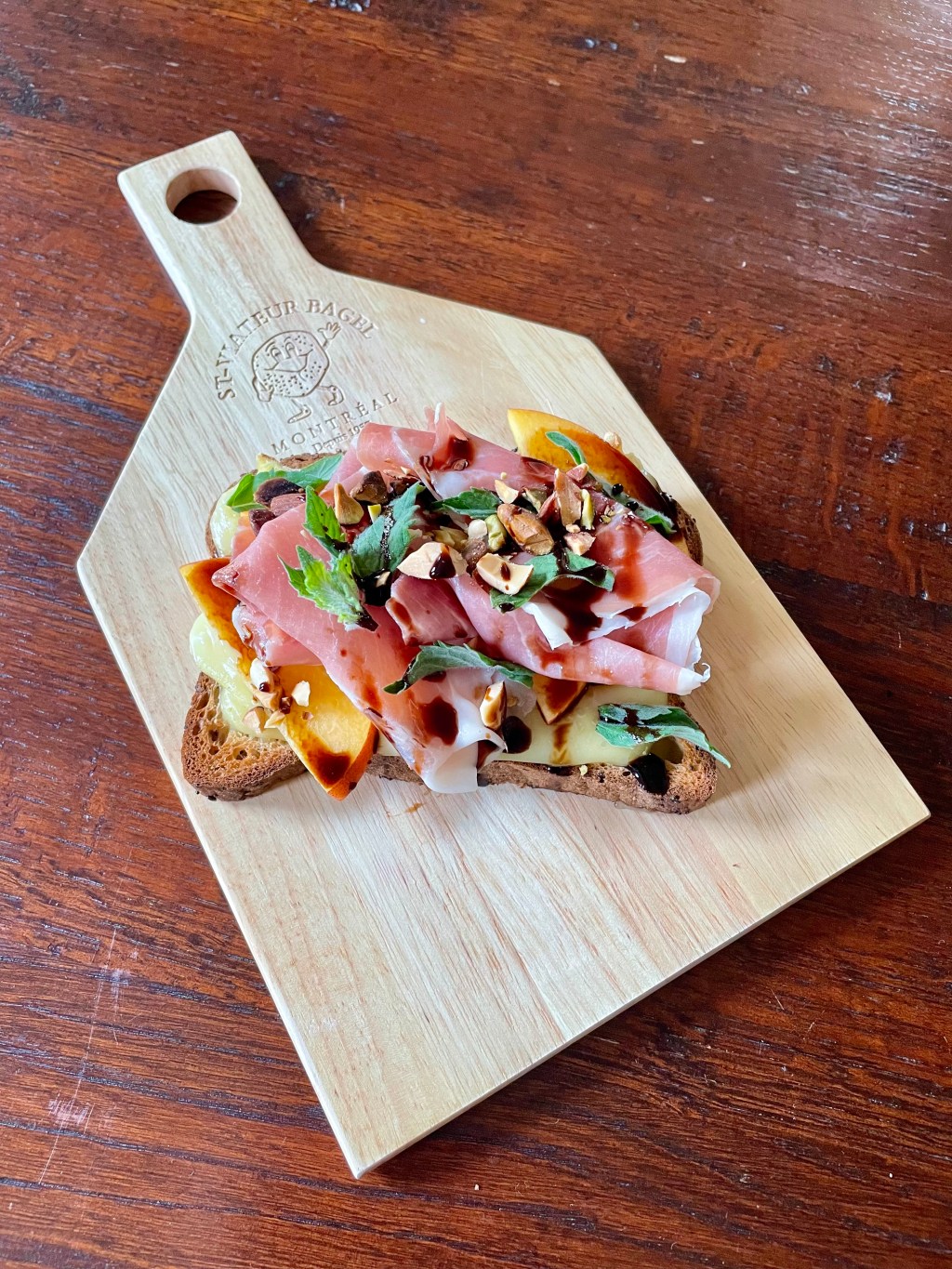
This toast makes and excellent brunch or appetizer that celebrates stone fruit season (one of the best times of year). The bright, tart flavour of the nectarine is complimented by the creamy, tangy Camembert and these flavours are mellowed by the saltiness of the prosciutto and toastiness of the nuts. The mint and balsamic tie everything together.
The Recipe
Prep time: 5 mins
Cook time: 6-8 mins
Assembly time: 2 mins
Start-to-finish time: 13-15 mins
Complexity: 3/10 (a couple slightly finicky elements like removing some of the Camembert rind and toasting the nuts)
Budget: Using the proportions listed below, a single toast will cost $5-$7 (cost-reducing tips in the “Simplify It” section below the recipe!)
Occasion: this is very much a summer toast, based on the time of year when nectarines are in season! It makes an excellent breakfast or brunch for yourself or for entertaining (it’s very easy to scale this up for lots of people) and an excellent summer appetizer.
The Ingredients
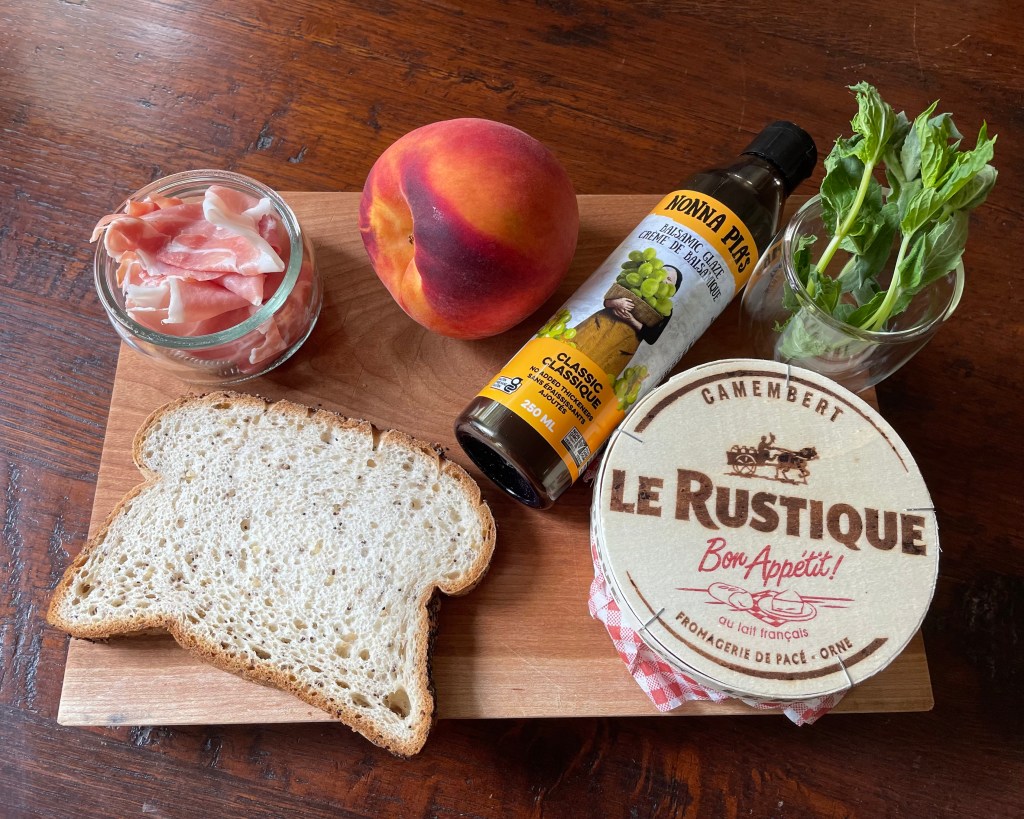
- One slice of bread (Promise Quinoa and Chia Loaf pictured here, but this would also be very good on a baguette, flatbread, focaccia, or any enriched-dough bread like challah or brioche.
- A few slices of prosciutto (there are 3 pictured here)
- One ripe nectarine (you’ll only need about half the fruit, unless yours is particularly small)
- A few sprigs of fresh mint
- A wheel of Camembert cheese (you’ll need only a few slices, enough to cover the surface of the bread)
- Balsamic glaze—you can make your own or get the store-bought stuff; Nonna Pia’s is my go-to!
- About 1/4 cup total of roasted, unsalted almonds and pistachios without the shells for toasting (not pictured here)
The Equipment
- Sharp knife
- Cutting board
- Broiler (I like to do this in the toaster oven/air fryer)
- Toaster (if you’re already using a toaster oven then you don’t need an extra toaster)
The Steps
- Prep your cheese & nectarine slices:
- Cut the nectarine into enough slices to cover your bread’s surface in a single layer. If you’re doing this on a baguette, you’ll only need one slice of nectarine per toast.
- Slice enough pieces of Camembert (no more than 1cm thick) to cover the surface of your toast in a single layer. Remove as much of the rind as you like, eating in mind that this will add a few mins to your prep time. I usually leave most of the rind on for more intense Camembert flavour. You could remove the rinds of the middle pieces to create a homogenous texture after it melts.
- Lightly toast the bread (not to brown it but to give it some structure so it doesn’t get soggy when you melt the cheese overtop). Don’t fully toast it, as you’ll be cooking it again at a later-stage (aim for level 2 or 3 on your toaster if your bread is defrosted and 3-4 if it’s frozen).
- While the bread is undergoing its initial toast, start toasting your nuts:
- Warm a small frying pan over medium-high heat
- Once it’s warm (hover your open palm about 30-40cm over the surface—do NOT touch the pan—and if you feel some good heat then it’s ready to go!), reduce the heat to medium-low and add your almonds and pistachios
- Toast by stirring very frequently with a spatula or wooden spoon. Be careful not to leave them sitting in one place for too long or they’ll burn. Toast the nuts until their colour starts to deepen and they become aromatic, around 5-7 mins.
- Remove the nuts from the heat onto a cutting board. Using a large knife, coarsely chop the nuts.
- Set them aside to cool
- Once the initial toast is complete, lay the slices of Camembert on top of the toast in a single layer. Broil the cheese-topped toast until the Camembert is melted (3-5 mins).
- Top the melted cheese with the prosciutto, then the nectarines. Drizzle the glaze on top.
- Top with the toasted nuts and a few leaves of that fresh mint
- Enjoy!
The Extras
Simplify it
The Cheese: This toast would be just as delicious without melting the cheese! Especially if you prefer more rind on your Camembert or if you’re pressed for time.
The Nuts: If you prefer, you can skip the step of toasting the nuts. And it doesn’t have to be almonds & pistachios—this would also be delicious with basically any kind of nut you have on hand (e.g. pecans, walnuts, macadamia, etc.), although I wouldn’t recommend peanuts.
The Meat: Swap out the prosciutto for another kind of mild cured meat product. You could also make this with bacon
The Glaze: If you don’t have access to balsamic glaze, you could spoon a little bit of balsamic vinegar on top of the peaces and top the toast with honey to mimic the flavours
The Mint: Dried mint would also work here! You could also use other herbs like rosemary on this toast, although mint gives it a unique freshness. If you don’t have any dried or fresh herbs on hand, you could accompany this toast with a mug of peppermint tea instead!
The Fruit: This toast would also be delicious with any kind of peach, fresh apricot, or plumb instead of nectarine! Whatever stone fruit you have available would work great.
Scale it up
The Glaze: If you want to infuse the balsamic glaze with specific flavours (maybe rosemary or cherries?) you could make your own! It’s very simple: combine 1 part balsamic vinegar with ½ part brown sugar or honey, plus any aromatics/flavourings you want to add. Combine the ingredients in a saucepan and cook over medium heat until the sugar is dissolved and the mixture is bubbling. Reduce the heat and simmer until the liquid has reduced by half and coats the back of a metal spoon (depending on how much liquid you add, this could take anywhere between 20 minutes to an hour). Then, let the liquid cool, remove any aromatics (passing the liquid through a strainer is an easy way to do this) and store in the fridge.
The Sweetness: A way to boost this toast’s sweetness would be to caramelize or even to brûlée some or all of the nectarine slices before adding them on top of the camembert. To caramelize the nectarine slices, add them to a pan with some butter and brown sugar over medium heat. Let them cook in a single layer on the bottom of the pan over medium heat for a few minutes until the underside begins to turn brown (check periodically). Then, flip the slices and repeat. To brûlée the slices, top them with some white sugar and use a kitchen torch to cook the sugar until it’s brown and crunchy.
- You could also candy the mint leaves! Here’s a link to a recipe that explains how to do that: https://hurriedhostess.com/candied-mint-leaves/
The Nectarines: Consider grilling the nectarines before adding them to the toast!
The Garnish: To really step up the visual appeal of this toast and give it a serious summer aesthetic, consider adding edible flower petals like those from petunias, chrysanthemums, or chamomile. Make sure you add these after the balsamic glaze has been added, otherwise the glaze will weigh down the flower petals and it won’t be as pretty.
About the Ingredients
Nectarines
It’s likely that the domesticated nectarine is 4000+ years old, originating in China and Central Asia. The wild nectarine, though, is actually the result of a naturally occurring genetic mutation of the peach. The only genetic difference between the two fruits is that the nectarine has a recessive trait: the lack of fuzz on its skin (which the peach is, of course, known for). The lack of fuzz causes the fruit to bruise more easily. In stone fruit orchards, nectarines and peaches can be found growing side-by-side from the same tree. After their domestication in China and Central Asia (especially historical Persia), nectarines eventually reached the Middle East, Ancient Greece, and Rome through trade routes. By the time the late 16th Century rolled around, nectarines made it to England and up through Northern Europe. They were brought to North and South America by Spanish explorers and places like California, Argentina, and Chile remain primary producers of nectarines in those parts of the world.
When nectarines reached California, it’s said they had consistently white flesh. Although its taste was popular, farmers found the fruits to be too fragile for large-scale production, so they crossed them with peaches to improve their sturdiness. This produced the orange-fleshed variety of nectarines. In addition to the colour of the fruit’s flesh, nectarines can be defined by the way in which the flesh and the pit are connected: whereas in clingstone varieties, the fruit clings tightly to the stone, the pit falls away from the fruit easily in the freestone varieties.
It’s a common myth that white-flesh nectarines have higher sugar content than orange ones. The reality is that they both contain the same concentration of sugar, but the orange-fleshed version tends to be more acidic, which leaves a tangy aftertaste and reduces emphasis on the sweetness. Nectarines are packed with Vitamin A and C!
My favourite nectarine fact is that the world’s heaviest nectarine was harvested in 2018 by Eleni Evangelou Ploutarchou in Cyprus. It’s 500g (over 1lb)! Here’s the Guinness Book of World Records post about it.
For more information about nectarines, check out these resources:
- Speciality Produce: https://specialtyproduce.com/produce/Nectarines_1806.php
- Tufts University: https://nesfp.nutrition.tufts.edu/world-peas-food-hub/world-peas-csa/produce-recipes/nectarines#:~:text=Nectarines%2C%20like%20peaches%2C%20were%20first,from%20which%20nectarine%20is%20derived.
- Britannica: https://www.britannica.com/plant/nectarine
Camembert Cheese
This cheese is legendary. Literally. Here’s the legend: This creamy, bloomy soft rind cheese was first invented in the village of Camembert in the Normandy region. The official regional protected variety is called Camembert de Normandie, which includes milk from heritage herd cows that is fed on nutritious grass that grows year-round thanks to the region’s wet climate. It’s said that the birth of Camembert is tied to the French Revolution: Marie Harel, a dairy farmer in Camembert, sheltered an Abbott and cheese maker from Brie (the place that brie cheese is named after) who was fleeing the revolution. In return for her kindness and his safety, the abbott showed her how to make Brie cheese. She then made small refinements to the process and Camembert was born. Harel passed her cheese-making secrets onto her daughter and the specific Camembert process has remained in the Harel family for generations. In the 1860s, one of Marie Harel’s grandsons presented some Camembert cheese to Napoleon III, who gave it his royal seal of approval.
Another fun fact: those little wooden boxes that Camembert is sometimes sold in are actually historically important. During the 19th Century, when cheesemaking was becoming industrialized, a French engineer invented the small wooden boxes specifically for transporting the cheese long distances, allowing it to reach North America. It also allowed it to be sent to French soldiers in the trenches during WWI, further embedding it in French popular culture and heritage.
Camembert is made by combining (traditionally unpasteurized) cow’s milk with rennet to form a soft curd. The curd is then formed into a small cylinder mold and left to drain. The small cylinders of cheese are salted and ripened for about two weeks before they’re wrapped in ripening paper. This salting and initial ripening process kicks off the formation of the classic, cloudy, edible rind. The rind is made up of microbes, which slowly ripen the cheese from the outside in. As the microbes work to break down the proteins and fats in the cheese, the area right beneath the rind forms a very soft, liquid cream line. This cream line expands gradually to take over more and more of the interior of the cheese as it ages. This results in stronger flavours and aromas. It’s typically sold after one month of ripening, but can definitely be aged for longer.
For more information on Camembert cheese, check out these resources:
- The Cheese Grotto (sounds absolutely idyllic) https://cheesegrotto.com/blogs/journal/what-is-camembert-cheese
- Taste Camembert.com https://www.taste-camembert.com/en/102-history.php
- History of Cheese.com http://www.historyofcheese.com/cheese-history-section/camembert-benefits-and-history/
Prosciutto
Prosciutto is a speciality cured pork product from Italy. It’s made from only the hind legs of the pig and can be separated into two categories: prosciutto cotto, which is cooked then cured, and prosciutto crudo, which is only cured. Both types are cured during their aging process. Regional varieties may vary in their flavour profiles and preparation process. For example, while Prosciutto di Parma from the Emilia-Romagna region is known for its intensive curing process and rich and salty flavour, Prosciutto di San Daniele from the village of San Daniele in the northern region of Friuli Venezia Giulia is known for its slightly sweeter taste. Producers of Prosciutto di San Daniele attribute its unique taste to the air of the region in which it’s dried, which is near the Adriatic sea.
It’s likely that the practice of curing and drying meat was borne out of the need for preserving the protein for long periods of time before refrigeration technology was around. One of the most well-known reference to prosciutto-style ham was in 100 BCE by the Roman statesman Marcus Porcius Cato (“The Censor”). Cato praised and celebrated the unique flavour and texture of hams from Parma. At that time, rather than a lard-layering step, the prosciutto’s curing process was supplemented with a step wherein the hams were covered in oil after being salt-cured and aged for a while. It’s also said that salt-cured, preserved pork legs were traded between Greece and the rest of Italy through the Etruscan-controlled Po River Valley. These hams are understood to be an ancestor to modern-day prosciutto.
The meat curing process is intensive and involves copious amounts of sea salt. A maestro salatore (salt master) covers the leg of pork in two layers of sea salt, both preceding a period of refrigeration. By the end of these two salting and cooling phases, just over 3 weeks have passed. The hams are then transferred to a second refrigeration setting, where they’re hung to dry in the cool environment for 60-90 days. This allows the salt to be absorbed and the curing process to really begin. Then, the salt is washed away and the hams are hung to dry in dark, airy spaces. The exposure to Italian sea breezes is extremely important for this part of the process. At this stage, the soon-to-be Prosciutto di Parma undergoes a lard-layering process before its final curing stage. The hams are then inspected by scent—using a needle made out of horse femur, prosciutto inspectors puncture a tiny hole in each ham. The inspector then smells the horse-bone needle, checking for scents that would indicate spoilage or flaws. These special needles are made from horse bone because its composition allows it to absorb and subsequently release scents very quickly. This allows the inspector to perform the sniff test and use the same needle for the next ham, without bringing any of the first ham’s scents to the second. Prosciutto di Parma is required by law to be aged for a minimum of 400 days to assure quality and complexity of flavour. Comparatively, Prosciutto di San Daniele must be aged for a minimum of 13 months.
My favourite fact about prosciutto is that there’s a Prosciutto di Parma DOP festival every September in Parma, Italy. It’s been running for 27 years and is described on their website as “a great party where you get to know and taste Parma Ham and enjoy the cultural and natural beauty of its places of origin.” Sign me up.
In case you’d like to learn more about prosciutto, check out these resources:
- How Prosciutto di Parma is made: https://parmacrown.com/what-is-prosciutto/
- History of Prosciutto di Parma: https://wineandtravelitaly.com/history-of-prosciutto-di-parma/
- Brief summary of other varieties of Prosciutto: https://www.britannica.com/topic/prosciutto-ham
- Parma ham festival: https://www.festivaldelprosciuttodiparma.com/en/
- Fun facts and tips for consuming Prosciutto di San Daniele: https://prosciuttosandaniele.it/en/the-ham/instructions-for-use/
Mint
Mint comes in many different varieties and flavours, including peppermint, spearmint, corn mint, Scotch mint, and at least 2996 other varieties. In Canada, peppermint is probably the most ubiquitous (so much so that it’s escaped cultivation and grows as a weed). Peppermint’s flavour is owed to the essential oil menthol, which can be collected for use in your toothpaste, diffuser, candle scents, etc. by chopping and steaming the peppermint leaves and stems and condensing the oil.
Mint’s history is seriously extensive and spans ceremonial, medicinal, and culinary contexts. It appears in the ancient Egyptian Ebers Papyrus (one of the oldest surviving medical texts in the world) from 1550 BCE, wherein it’s suggested that mint can be used to soothe flatulence. In both ancient Greece and Rome, mint was used as body scent and in funerary rites. Pliny the Elder (an author, military commander, naturalist, and philosopher from the early Roman Empire) suggested that applying broth made from mint to your temples could help get rid of a headache. There are even ancient Greek physicians (Galen & Dioscorides) who believed that mint could prevent women from becoming pregnant (imagine that…). Since at least the early 1600s in Europe (and perhaps earlier in other parts of the world), mint has been associated with serenity, relaxation, peace, and focus. This was put into explicit recommendation by the physician Tobias Venner in 1620 (check out pages 158–159 of this book). Herbals (books that detail the physical and medicinal effects of plants) from the early modern era documented the soothing properties of mint to the digestive system, which it’s still known for today.
Mint also has a history in Greek mythology. The story goes that there once was a beautiful river nymph named Minthe. Unfortunately, Minthe fell in love with Hades. In retaliation to Minthe claiming to be better than Hades’ wife Persephone, Persephone turned Minthe into a plain-looking, small plant that would grow abundantly. These properties made it so that the plant would be frequently stepped on by others. In an attempt to comfort and console Minthe, Hades gave her a delightful, sweet, minty fragrance so that people would at least associate her with something pleasant and sweet. Ancient Greek uses of mint included scattering the leaves on floors as air fresheners, incorporation into funeral rites, and ingestion to cure stomach troubles. Mint is therefore a sacred plant that grows abundantly in the south of Greece.
There are so many more interesting things to learn about mint (more than I can type out here). Here are some links to check out if you want to read more about the delicious and refreshing herb:
- JSTOR’s plant of the month https://daily.jstor.org/plant-of-the-month-mint/
- Herbs in History (my favourite academic blog about herbs): https://www.ahpa.org/herbs_in_history_mint
- Barkley’s Mints breakdown of Peppermint vs. Spearmint: https://www.barkleysmints.com/page/mint-history
- The Museum of Food and Drink’s history of mint: https://next.voxcreative.com/sponsored/10709952/a-brief-history-of-mint-from-air-freshener-to-breath-freshener
- The Canadian Encyclopedia: https://www.thecanadianencyclopedia.ca/en/article/mint#:~:text=Mint%20has%20been%20used%20by,escaped%20cultivation%20and%20become%20weeds.
Balsamic Glaze (Balsamic Vinegar)
Balsamic glaze is made of balsamic vinegar and sweetener (sugar or honey). The two ingredients are combined and then reduced on the stove, thickening as the water evaporates from the mixture. Interestingly, this 1980s invention (yes, it’s that recent) is actually not as much of a novelty as you might think: it’s really an attempt to bring the most authentic, traditional version of balsamic to tables in places that can’t access it (i.e., most places outside Italy). The traditional method of making balsamic results in a rich, sweet, and very thick mixture made from Italian grapes and aged for decades (and sometimes centuries) in wooden barrels. Balsamic’s flavours vary by region, as artisans used local grapes and wood.
The precursors to balsamic vinegar are ancient: vinegars and the musts of apples, dates, and figs have been in widespread culinary and medicinal use since the third millennium BCE in civilizations such as Mesopotamia, Ancient Egypt, Ancient Palestine, Ancient Greece, and Rome. But where did it go from there? And how did we get to balsamic vinegar as we know it today? And how did it get its name?
Here are some historical highlights of balsamic:
The word “balsamic” comes from the word “balm”, which refers to the (very historical) medicinal applications of balsamic—it was thought to help relieve labour pains, a sore throat, and was even thought to help protect people from contracting the plague.
The first ever written mention of balsamic vinegar is from the year 1046 CE. In this historical record, Enrico III of Franconia, who was about to become the Holy Roman Emperor, requested a little silver bottle of balsamic from Marquis Bonifacio on his way to Rome. A little later, in 1115, the Benedictine monk Donizone of Canossa wrote the poem Vita Mathildis, which tells the story of Mathilda of Tuscany and mentions balsamic. Check out an English translation of the poem here, or if your Latin is good, you can download a transcription/facsimile scan of the original text here. In 1288, it’s reported that Obizzo II d’Este, who was closely associated with the Lordship of Modena, kept many barrels of balsamic vinegar at his court. In the 1400s, historical records from Este courts start popping up that classify different types of vinegars (including balsamic). This is essential because it allows balsamic to develop its own identity. About a century later the Italian poet Ludivoco Ariosto mentions the inclusion of balsamic at mealtimes in 1518 at the Etensi court. Ariosto writes about how vinegar and sapa (a thick concentrate of grape must) were frequently used as condiments in Emilian society.
Importantly, when Modena became the capital of the Estensi dukedom in 1598, dukes from across the regions brought their vinegars and regional balsamic recipes with them to the capital. Balsamic became so popular so quickly that Modena soon took ownership of the condiment, earning a DOP designation. From then on, Modena became the central hub for balsamic production. For example, the Giusti family has been one of the major producers of balsamic in Modena since 1605 and they continue to be one of the major producers of the product.
Jumping forward to the 1700s, balsamic vinegar was noted as part of grape harvests and private sales in the secret cellars of dukes across Italy. The first commercial marketing and sales of balsamic vinegar were carried out by the French during the Napoleonic invasion of Italy in 1796-7. Prior to this, the widespread distribution of balsamic vinegar was unheard of and unthought of. Until then, balsamic was only accessible to nobility and the artisans creating the product and it was typically passed down to new generations within a family. So, each family tended to have their own unique recipe, leading to a wide range of regional and local varieties. This passing down of recipes and actual barrels of vinegar resulted in vinegar that had been aged for 50-200 years or more. At the time, this highly valuable balsamic was served by the droplet and was so coveted that it was sometimes included in a bride’s dowry.
Of course, these are just highlights in the rich and storied history of balsamic vinegar. If you’d like to learn more about it, check out these resources:
- Prospect (UK): https://www.prospectmagazine.co.uk/society/39351/a-short-history-of-balsamic-glazethe-sticky-condiment-that-epitomises-an-era-of-british-culture
- Nonna Pia’s (who makes the glaze I put on this toast): https://nonnapias.com/story-of-balsamic/
- Serious Eats “Everything you need to know about balsamic vinegar”: https://www.seriouseats.com/everything-you-need-to-know-guide-to-balsamic-vinegar#toc-balsamic-inspired-products
- Ambrosia Balsamico: https://www.ambrosiabalsamico.it/en/Story_of_Balsamic_Vinegar.xhtml?srsltid=AfmBOopGSd3ajlfDOFoLgu-lLaaqTgKeBdgjj5vFuxBtN5fCwlwIbZkG
- About the Giusti family and balsamic of Modena: https://giusti.com/blogs/balsamic-and-surroundings/the-balsamic-vinegar-of-modena-between-history-and-tradition
- Acetaia di Canossa (including stories about Balsamic and Catherine the Great): https://acetaiadicanossa.it/en/origins/history-of-balsamic-vinegar/#:~:text=In%201518%20the%20poet%20Ludovico,of%20this%20wonderful%20culinary%20product.
- A history that includes a TLDR at the top: https://www.anticoducato.com/en/a-little-history/
Pistacchios
Pistacchios have some serious lore behind them. First off, they’re native to the regions of Anatolia (Turkey), Iran, Iraq, Syria, Lebanon, Southern Russia, and Afghanistan. There’s even archeological evidence of pistachios as early in 6750 BCE near Jarmo in northeastern Iraq (although I’m not sure exactly what that evidence looked like…was a it a whole pistacchio? A pistacchio fossil? A depiction of someone eating a pistacchio? This remains a mystery—we need an archeologist). Speaking of archeological evidence of pistacchios, Britain’s oldest pistacchio was found at the bottom of an ancient well in North Yorkshire during highway upgrade work. It’s over 2000 years old (how is it not disintegrated?).
The cultural roots of pistacchios run deep, too, and they’ve been enjoyed *religiously* throughout history: they’re said to have been in the hanging gardens of Babylon during the 8th Century BCE under the reign of King Nebuchadnezzar. Pistacchios are also one of two nuts mentioned in the Old Testament (Genesis 43:11), where they’re praised as “some of the best products of the land.” They’re also believed to be one of the foods that Adam brought to earth and grew in the Garden of Eden. And we can’t forget about the Queen of Sheba: during her reign she decreed pistacchios to be an exclusively royal tree nut, forbidding commoners from growing or purchasing them for themselves. In the first century BCE, the ancient Greek astronomer and politician Posidonius recorded that pistacchios were being cultivated in Syria. The nuts travelled from there to Italy during the first century CE and spread quickly through the Mediterranean regions from there. The nuts make it all the way to China by the 10th Century and was introduced to the US in 1854. Although commercial cultivation of pistacchios didn’t start until the 1970s, the US remains a larger grower and exporter of the nuts. They’re also grown in Australia, in addition to the places they originated.
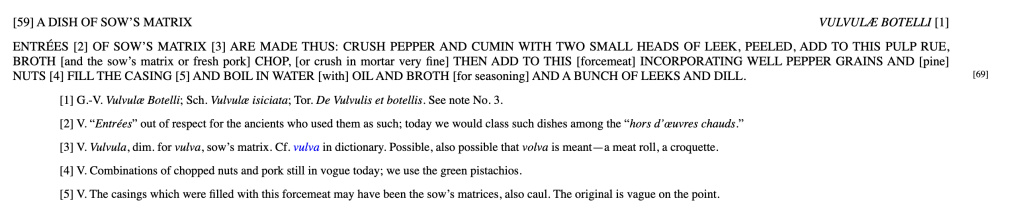
Pistacchios are also featured in the book Apicius, which is also called De re culinaria and De re coquinaria, which is an ancient collection of Roman recipes, likely compiled between the first and fifth century CE. Here’s a screenshot of a recipe that uses pistacchios from an English translation of this source:
There’s lots more to learn about pistacchios! Check out these sources for more info:
- https://americanpistachios.org/growing-and-harvesting/history (about how pistacchios made their way to the USA)
- https://www.sciencedirect.com/science/article/pii/B9780857090904500111#bb0305 (a great peer-reviewed article about the origins, history, botany, harvesting, and anatomy of pistacchios by researchers M. Kashaninejad at the Gorgan University of Agricultural Sciences and Natural Resources, Iran, and L.G. Tabil at the University of Saskatchewan, Canada)
- https://www.britannica.com/plant/pistachio-plant (general info about pistacchios in their very own Encyclopedia Britannica entry)
- https://www.britannica.com/biography/Marcus-Gavius-Apicius (the Britannica entry about the ancient cookbook)
- https://jerryjamesstone.com/how-to/history-of-pistachios-what-am-i-even-eating/ (more on the history of the nut and its cultivation in California)
- https://www.bbc.com/news/uk-england-york-north-yorkshire-57862964 (the BBC article about Britain’s oldest pistacchio)
- The full English translation of the book can be found here: https://www.gutenberg.org/files/29728/29728-h/29728-h.htm
Almonds
Did you know that almonds used to be dangerous? Almond trees are one of the first domesticated trees (starting between 4000 and 3000 BCE), but people couldn’t have domesticated them until almonds stopped being bitter and poisonous. This transition happened naturally as a result of a genetic mutation that turned off the genetic code for creating cyanide toxins within the plant. Before this mutation, though, less than 50 almonds contained enough cyanide to kill an adult (yikes). The toxicity of wild almonds is caused by a chemical compound called amygdalin, which becomes problematic (dangerous and bitter) when digested. Cultivated, sweet almonds contain hardly any amygdalin, so any cyanide that results from its digestion is not dangerous.
Ancient peoples had a cool trick for turning the almonds from toxic and bitter to safe and sweet: they pierced the trunk of the tree near the roots and jammed a thick stick of pine into the cut. According to St. Basil’s homilies in the Hexaemeron (a book of homilies that comment on the creation of the world, from the 4th Century CE), this procedure causes the almonds to lose their acidity and become “delicous fruits”. Today, scientists believe that the transformation the almonds underwent as a result of this seemingly strange act was the consequence of stressing the plant, which blocked the production of toxins. It’s unclear who came up with this idea…I get the feeling it was pretty unlikely to go around stabbing trees with other trees (did they ever try to stab pine with almond?).
The almond tree originates from Western and Central Asia and after their domestication, were traded across Asia and the Mediterranean along the Silk Road. Almonds were considered a luxury item and were often presented as a gift. Here’s a link to a timeline of how almonds have played a part in history and how they ended up in the US: https://www.almonds.com/about-us/global-history
The almond tree has been cultivated in Iran and other countries in Western Asia for over 6000 years. It was introduced to Greece in the 5th century BCE, from where it spread to other European countries after the 3rd century CE. The fruit of the almond tree was seen as a luxury foodstuff and often presented as a gift. The trees flower in the spring and the almond nut has a variety of uses from culinary applications to cosmetics.
Check out these other sources to learn more about almonds:
- https://ayoubs.ca/blogs/news/the-origin-and-history-of-almonds?srsltid=AfmBOoqGUuPVHqLsto4hhZiquz5st0n7HMdgCp_NtvXoFDW6ZOJPfEbj (if you’ve ever lived in Vancouver, I hope you know and love Ayoub’s—best fruit and nut store I’ve ever been in)
- https://www.liveholos.com/blogs/journal/the-story-of-almonds?srsltid=AfmBOoqRRcS_8VxmBJBuVWcq4EfcQ4bCChd7kcnj-zKEO11iPLruXwLu (the story of almonds “From Rags to Riches”)
- https://www.documentacatholicaomnia.eu/03d/0330-0379,_Basilius_Magnus,_Homiliae_IX_in_Hexaemeron_[Schaff],_EN.pdf (an English version of the Hexaemeron with an introduction)

 Put it on Toast!
Leave a comment