
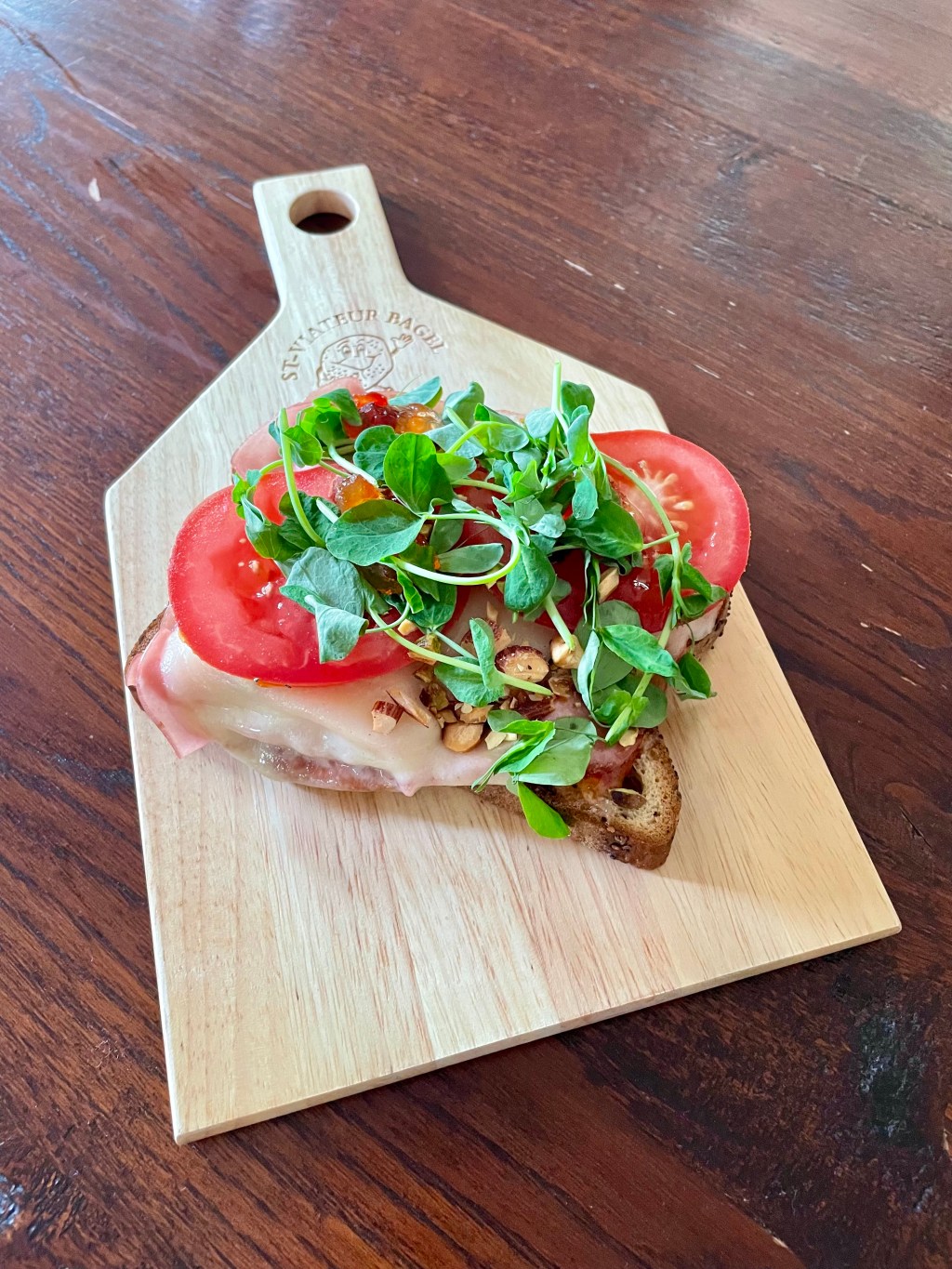
The perfect quick lunch or appetizer that balances the sweet and savoury, this toast has all the deliciousness of a grilled cheese or panini with none of the precarious flipping or griddle cleaning that comes with those two sandwiches.
The Recipe
Prep time: 2 mins
Cook time: 6-8 mins
Start-to-Finish time: 8-10 mins
Complexity: 2/10
Budget: Using the proportions and products listed below, one toast with these toppings costs approximately $5.00
Occasion: This toast is perfect for a savoury lunch or light dinner. If you slice the fully assembled toast into strips, it makes the perfect dinner party appetizer.
The Ingredients
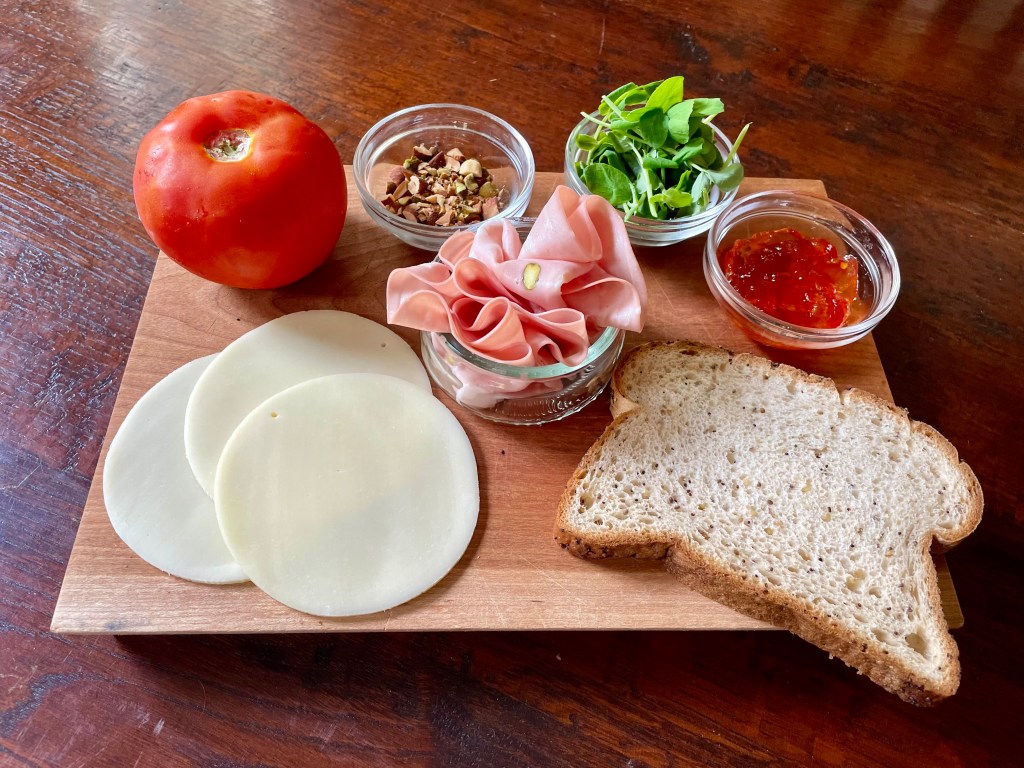
- One slice of bread (Little Northern Bakehouse Quinoa and Chia Loaf pictured here, but this is also great with Schär Deli-Style Sourdough)
- Three slices of mortadella (with or without pistachios!)
- 3 slices of provolone
- ~3tsp red pepper jelly
- A small handful (~10g) of pea shoots
- 2 slices of tomato
- Some chopped, toasted pistachios and almonds (optional, but especially delicious if you chose the mortadella with pistachios in it, like is pictured here)
- Some butter or margarine (not pictured & optional)
The Steps
For toasting the nuts
- Warm a small frying pan over medium heat
- Once it’s warm, reduce the head to low
- Toss in about ¼ cup of unsalted, toasted nuts of your choice
- Toast by stirring very frequently with a spatula or wooden spoon. If you leave them sit in one place for too long, they’ll burn.
- Toast until the colour of the nuts starts to deepen and they become aromatic, around 5-7 mins.
- Remove them from the heat onto a cutting board. Using a large knife, coarsely chop the nuts.
For the toast
- Warm a non-stick pan over medium heat.
- Once the pan is heated, toast your bread to its desired done-ness in the toaster or toaster oven.
- While the bread is toasting, place one slice of provolone on the bottom of the hot pan. On top of the quickly melting cheese, place your three slices of mortadella. Top the mortadella with the remaining two slices of provolone and cover with a pot lid that approximately matches the diameter of the pan.
- For best results, don’t layer the slices of mortadella flat on top of each other. Instead, let the slices naturally crumple into little mounds on top of the cheese, like how they look in the ingredients photo, above.
- Let the meat and cheese cook together until the top layer of cheese is melted and the bottom slice has a nice brown crust underneath. This usually takes 4-5 minutes.
- After the toast is finished, spread some butter/margarine (optional) and 90% of the red pepper jelly on top. Reserve some of the jelly to pop on top at the end.
- Once the meat and cheese have been sufficiently cooked, scoop the beautiful melted mixture out of the pan with a turner/flipper spatula and slide it onto the toast.
- Place the two slices of tomato on top of the meat and cheese, followed by the pea shoots (spread relatively evenly over the top).
- Finish with the chopped toasted nuts (optional) and the remainder of your jelly—little dabs of jelly along the top of the toast will enhance the flavour!
- Enjoy!!!
The Extras
Check out what the beautiful combo of mortadella and provolone looks like in the pan! Sound up for that sizzzzzle.
Simplify it:
The meat and cheese: If you don’t want to pull out another pan, you could melt the cheese and meat together on top of the toast under the broiler. This will take a bit more time, as you’ll want to make sure you melt the meat and cheese on top of toasted, rather than un-toasted bread (skipping this step will result in toast that has very little structural integrity!).
If you don’t like mortadella or provolone, sub for your favourite deli meat and melty cheese! Ham and cheddar or turkey and brie would be just as delicious. If you’re vegetarian, you could leave out the meat altogether! I’d recommend adding a bit of salt if you do. If you leave off the meat, consider turning this into more of a Cheese Dream.
The tomatoes: You could leave the tomatoes off if you prefer!
The red pepper jelly: Try swapping out the red pepper jelly for another spread like fig jam, rhubarb spread, or unsweetened applesauce. If you use a spread that contains more moisture like applesauce, I’d recommend that you drizzle it on top of the whole toast rather than spreading it on the bottom to avoid soggy bread.
The pea shoots: Instead of pea shoots, you could use another kind of fresh sprout, like alfalfa, or you could sub a roughly chopped herbs like basil or parsley. You could also chop up some spinach or lettuce to place on top!
Scale it up
This toast highlights its component ingredients, so scaling up your toast will have much to do with the quality of the meat, cheese, shoots, tomatoes, and jelly that you purchase. That being said, here are some component-specific recommendations:
The base: Consider changing the base to a nice artisan bread from your local bakery rather than a slice out of a loaf! This toast would be amazing on a baguette or a freshly baked slice of sourdough.
The cheese: Consider flipping the meat and cheese mixture over so that there’s browning on both sides.
The tomatoes: Be choosey with your tomatoes! Try different varieties and sizes of tomatoes atop your toast to lend it different flavours and textures. You could also try swapping the tomatoes for slices of apple.
The garnish: Top your toast with toasted nuts (double toastttt)! Get creative with the nuts you choose to top your toast with!
About the Ingredients
Mortadella
Mortadella is a kind of emulsified pork sausage that is said to originate from the Emilia-Romagna region of Italy. Emulsified sausages consist of finely ground meat that is combined with fat into a relatively homogenous mixture resulting a silky texture. Non-emulsified sausages have a more marbled appearance, with speckles of fat and meat protein distributed throughout.
A predecessor of mortadella is an ancient Roman pork sausage that was made by finely grinding together pork meat and fat with myrtle berries and pepper. The historical evidence for this is an ancient Roman stone carving that depicts seven pigs being led out to pasture with a mortar and pestle. Another theory suggests that the primary precursor of mortadella comes from the Celtic Galli Boi tribe and their love for cooked, spiced pork. It’s said that people from this tribe and others inhabiting central Europe during pre-Roman times introduced pork farming to northern regions in Italy, including Emilia-Romagna. Another theory still suggests that mortadella emerged out of a pork cooking practice of the Frati Gaudenti, the historical militia of the Virgin Mary in Italy. You can find more information about the Frati Gaudenti here.
Regardless, Mortadella as we know it today (full name Mortadella Bologna) actually has a birthday: October 24th, 1661. On this day, Cardinal Girolamo Farnese officially defined and declared the formal production techniques for the sausage. This led to the establishment of the Italian Consortium for the Protection of Mortadella Bologna, which is responsible for upholding mortadella standards, claiming to guarantee mortadella’s safety, quality, Italianness, and uniqueness (quoted directly from their website). The official specifications for crafting authentic Mortadella Bologna can be found here (this document is in Italian). The sausage is celebrated every year in Zola Predosa, Bologna, Italy where they put on the Mortadella Please festival. The whole place is decked out in pink and there are local mortadella manufacturers and vendors who celebrate the products history and deliciousness. The festival features a display of both new and traditional mortadella recipes, tours of mortadella production facilities, artistic performances, and a children’s area called MordatelLand.
Other pop-culture celebrations of mortadella include the film Lady Liberty, whose Italian title is La Mortadella. The plot goes something like this: an Italian woman is engaged to an American man and she travels to New York for her wedding. She brings her fiancé a large mortadella sausage as a gift, but customs officers in New York won’t allow her to bring it into the country because of the law prohibiting the import of meats from foreign countries. She refuses to allow them to confiscate the sausage from her, which causes an international diplomatic incident.
Distinct from other well-known Italian cold cuts like prosciutto, mortadella is cooked rather than cured. To make mortadella, producers begin by selecting the highest quality cuts of pork, usually from the shoulder of the pig. This is then minced finely and mixed together with pork lard, spices, and natural flavours (often including pistachios, peppercorns, and/or myrtle berries). The lard is both mixed throughout and added in small chunks/cubes (the little white bits you see in the slices are pork fat). The mixture is then stuffed into casings (today, these are often synthetic casings, but historically they have been made of pork bladder). The stuffed sausages are then baked in a convection oven for several hours, until the core of the sausage reaches 70ºC. The sausages then undergo a water bath to stop the cooking and are left to rest and age to perfection!
Check out these websites for more information on mortadella!
- Wine and Travel Italy: https://wineandtravelitaly.com/the-origins-of-mortadella-bologna-igp/
- Official Roma Dal Bolognese website: https://roma.dalbolognese.it/en/mortadella/
- Salumi Pasini: https://salumipasini.com/en/what-is-mortadella/
- Mortadella consortium: https://bologna.bestsocialpages.com/consorzio/?lang=en
- Mortadella consortium: https://bologna.bestsocialpages.com/mortadella-bologna/?lang=en
- History of how pig farming came to Italy: https://www.deliciousitaly.com/emilia-romagna-food-wine/celts-pigs-and-ham
Provolone Cheese
Provolone is a semi-hard, cow’s milk cheese. It’s a type of pasta filata (“spun paste”) cheese, which means that part of its production process stretching the curds while they’re hot and forming them into a variety of shapes. Other well-known pasta filata cheeses include mozzarella and Oaxacan cheese. Check out this resource for 8 categories of cheese according to the French method of classification and examples of each! Provolone originates from the Lombardy and Veneto regions of the Po River Valley in Italy. The land in this area was made arable for livestock by the Cistercian monks, who were reclaiming the land around the river at the time. Like other Italian cheeses, provolone has a consortium governing and protecting its production according to a set of agreed upon standards set by the experts who make up the consortium’s membership. Unlike other meats and cheeses, though, the Provolone consortium wasn’t established until 1975 (this is quite late!). Here’s a web page published by the consortium that traces it’s history.
There are three main types of provolone cheese, whose characteristics and flavour profiles are determined by the type of rennet added to the milk and the amount of time they’re aged for.
Provolone dolce (sweet)
The sliced rounds of provolone you can purchase in the grocery store or from your local fromagerie are likely provolone dolce. This sweet, mild, and nutty cheese melts beautifully and is typically used in sandwiches/paninis, grilled cheese, or added to pizza. This variety is made by adding calf’s rennet to cow’s milk and heating the mixture to separate the curds from the whey. The curds are then heated up a bit more and hand stretched (the pasta filata process) and then moulded into a variety of shapes (here’s a cool diagram of some of the many shapes of provolone). Then, the cheese is bathed in cool brine to help it hold its shape. It’s then tied up with several ropes and hung to age and dry. Provolone dolce is typically aged for 2-3 months.
Provolone piccante (spicy)
This variety of provolone has a much stronger flavour and firmer texture than provolone dolce. Provolone piccante is made in almost the same way as provolone dolce, except for the type of rennet added to the milk, and for how long the cheese ages. Instead of calf rennet, goat rennet is added to the milk in the initial stages, which contributes to the cheese’s sharper flavour. Additionally, provolone piccante is aged for much longer—typically up to a year—allowing the cheese to firm-up and consolidating its flavour. Provolone piccante is often sliced up and added to cheese boards.
Provolone piccante stagionato
This variety is essentially provolone piccante that’s been aged even longer. It’s a very firm cheese that has a strong, pungent flavour. The consistency becomes closer to parmesan and it’s often shaved atop salads or grated over pasta.
Check out these resources for more information on provolone, its history, and its uses!
- The Cheese School of Paris: https://parolesdefromagers.com/en/everything-you-need-to-know-about-provolone-italian-cheese/
- The Cheese Scientist: https://cheesescientist.com/trivia/what-is-provolone-cheese/
- From the Provolone Consortium: https://www.provolonevalpadana.it/en/history-of-provolone-valpadana/
- Google Arts and Culture: https://artsandculture.google.com/story/provolone-valpadana-ministero-delle-politiche-agricole-alimentari-e-forestali/VgVxg7hIxQEA8A?hl=en
Red Pepper Jelly
Red pepper jelly is a preserve from relatively recent history that is said to originate from Texas, USA, where it continues to be extremely popular. Tracing the history of red pepper jelly turns out to be a tall order, though: most websites state that pepper jelly made from red jalapenos was first created (or maybe first marketed?) in Lake Jackson, Texas, in 1978, but they don’t give any further details. So we’re left with questions like “who created/marketed jalapeno jelly first?” “what stores did it appear in first?” “does that so-called original recipe build on older versions of the condiment?”. Thankfully, Barry Popik—contributor to the Oxford English Dictionary, among other has compiled a series of references to Jalapeno Jelly in newspapers and products offered earlier than 1978 across the southern US. Here’s his list. Another thing to consider is that the practice of turning fruit & veggies into jams/jellies is certainly older than 1978 (think: Ancient Greece) and chilli peppers are from Ancient South and Central America, so… tbd on the history of red pepper jelly.
The plus side to all of this digging is that I did learn that Dr. Pepper Jelly is a thing, where the hugely popular soda pop is combined with lemon juice, pectin, and sugar to create a jelly spread. Dr. Pepper Toast anyone? Check out this TikTok to learn more.
The most typical ingredients of red pepper jelly include red chilli peppers, cider vinegar, sugar, spices like garlic, and pectin. Red pepper jelly typically has a balance of spicy, sweet, and tangy flavours with a spreadable texture that goes well with a variety of cheeses (especially sharp, firm cheeses).
More generally, pepper jellies and jams (thicker, includes the seeds) are staple condiments of a variety of cuisines across the world. They’re often used as glazes and marinades for meat, in dressings for veggies and salads, and on cheese boards. In South America (the home of many, many chilli pepper varieties), much culinary research has been done on the kinds of chilli peppers that are best suited to creating jellies and jams. For instance, this 2018 article from the Journal of Food Science and Technology evaluates the extent to which the most consumed pepper varieties in Brazil are suitable for preservation in jam/jelly form based on a number of the peppers’ physical properties. Similar work was done in 2009 by Brazilian researchers. In many regions of Southeast Asia, pepper jellies are a very important condiment or dip. For instance, sweet chilli sauce is a jelly-like preserve very popular in Thailand that frequently combines use of hot Thai chillies, honey, garlic, and fish sauce. The kinds of peppers and other fruits that are incorporated into pepper jellies vary based on the popularity and availability of fruits and peppers in the region. For instance, in tropical places, it’s common to see mango or pineapple incorporated into recipes. Another example is this recipe for Calabrian Hot Pepper Jam, which makes use of the classic spicy peppers that are iconic of Calabrian cuisine.
Learn more about pepper jellies here:
- Wikipedia: https://en.wikipedia.org/wiki/Pepper_jelly#:~:text=4%20References-,History,to%20be%20with%20jalape%C3%B1o%20peppers.
- iFood.tv: https://ifood.tv/jelly/pepper-jelly/about
- Texas Monthly: https://www.texasmonthly.com/recipe/hot-pepper-jelly/#:~:text=Hot%20pepper%20jelly%20is%20said,popularity%20in%20Texas%20is%20indisputable.
- Pepper Jam: https://pepperjelly.net/blogs/news/the-history-of-pepper-jelly-a-sweet-and-spicy-culinary-journey
Tomatoes
Today, there are over 10k varieties of tomatoes. But the first wild tomatoes grew in the Andes region of South America, around northern (modern) Peru and southern Ecuador. The indigenous peoples in that area harvested the fruit and it made its way north to Aztec regions in modern-day Mexico. The Aztec and Mayan populations were the first to domesticate tomatoes around 500BCE. The Aztec people called the fruit xitomatl, and the tomatillo miltomatl, reflecting their visual similarity and distant botanical relationship (although they’re not related enough to be substituted for each other in a meal… think plantain & banana level of relation). After colonizing this area (learn more about this here and here), Hernán Cortés and his Spanish troops were likely responsible for bringing tomato seeds back to Spain, the fruit’s first touchdown in Europe. The word xitomatl (especially the “tomatl” part) was changed to tomate by the Spanish, bringing it close to its modern English name.
Interestingly, the fruit was widely rejected across Europe before it landed in Southern Italy in the mid-16th Century. There, it was incorporated into regional cuisine (for example, pizza as we know it today was invented in Naples about 200 years later, of which tomatoes were an essential component. Bear in mind, though, that pizza actually has much older roots in Ancient Greek, Egyptian, and Roman times). People in other parts of Europe falsely believed that tomatoes were poisonous, and reacted to the fruit with fear and rejection. It was even commonly referred to as “the poison apple”. While it’s true that the stems and roots of the tomato plant contain a neurotoxin called solanine (don’t eat tomato stems/roots…), the actual tomato fruit isn’t (and has never been) poisonous. The production of solanine is common amongst all nightshade fruits and vegetables and acts as an insecticide while the nightshade plants are growing. Potatoes are also a member of the nightshade family and when they turn green and/or sprout, they have more solanine in them, which is why people typically recommend that you don’t eat sprouted potatoes.
The idea that tomatoes were poisonous came from a false conclusion caused by a confounding variable. Upper-class people in Europe in the 1500s and later would often die after eating tomatoes, but it wasn’t the tomatoes that were the problem: plates at that time were maid out of an alloy of pewter and lead. The acid in tomatoes would cause the lead to seep out of the plates and into the food, causing people to die from lead poisoning, not the actual tomatoes.
The tomato was believed to be a relative of the eggplant by people in China and India, the latter of whose peoples especially embraced the fruit as a crucial part of many different regional cuisines. Turns out they were almost right: the tomato is very distantly related to the eggplant at the family level (although they’re from completely different genera).
Learn more about the history and spread of tomatoes here:
- Encyclopedia Britannica: https://www.britannica.com/plant/tomato
- University of Vermont: https://www.uvm.edu/news/extension/history-tomatoes#:~:text=Tomato%20seeds%20were%20brought%20from,primarily%20as%20an%20ornamental%20plant.
- An excellent YouTube video: https://www.youtube.com/watch?v=AG9Oc6TxDXU
Pea Shoots
Pea shoots (or “pea tendrils” in some parts of the world) are the very young snow pea plant. The leaves and the stalk are tender and sweet, and they taste just like sweet, fresh peas! They’re harvested very early in the life cycle of the pea, before the plant begins to flower (and much, much before the plant produces the pod of those little legumes we all know and love). These shoots are distinguished from pea sprouts by the method of cultivation and the stage of the life cycle during which they are harvested: whereas pea sprouts are grown in water and harvested after only a few days after growth begins, pea shoots are grown in soil (outdoors or in a greenhouse) and are harvested after a few weeks of growth, once the leaves have developed properly. Pea shoots are packed with nutrients, including fibre, vitamin C, iron, folate, and lower concentrations of calcium, vitamin A, and vitamin K.
Pea shoots can be eaten either raw or cooked, and their delicate, fresh flavour is best suited to gentler cooking methods like steaming, stir frying, and sautéeing (you probably wouldn’t bake pea shoots because they’d lose their crispness and flavour).
The wild pea plant originates from the Mediterranean. The earliest archeological evidence of peas points to the Neolithic era (from 10,000 BCE to 2200 BCE) in modern-day Syria, the Anatolia Peninsula in Turkey, Iraq, Greece, and Jordan. Slightly later, evidence of peas is found in Egypt—earlier in the northern part of the country near the Nile delta area (4800-4400 BCE) and later on in the central/more southern regions (3800-3600 BCE). Archeological evidence also points to cultivated pea crops in the Harappan civilization regions including modern-day Pakistan, western-, and northwestern India from 2250–1750 BCE, and in Afghanistan around 2000 BCE. Around the same time, there’s evidence of cultivated pea crops in the Ganges Basin region and Southern India. Peas are thought to be one of the world’s oldest cultivated crops and spread quickly throughout Asia, and later Europe, via trade.
Peas arrived in China during the first century BCE. Use of pea shoots in cooking, however, is credited to the Hmong people. During the 1800s, many Hmong people left China, spreading the practice of using pea shoots in cooking to countries across Southeast Asia, including Thailand, Laos, Cambodia, and Vietnam. The culinary use of pea shoots spread to the USA in the 1970s, when many Hmong people moved there following their persecution after the Vietnam War. This was pea shoots’ first contact with North America and their use in cooking was spread throughout the continent from then on. Now, they’re cultivated across the globe.
Check out these resources to learn more about pea shoots:
- Pacific Northwest Extension Peer-Reviewed article: https://wpcdn.web.wsu.edu/extension/uploads/sites/25/PNW567.pdf
- Wikipedia (the bibliography on this one is serious): https://en.wikipedia.org/wiki/Pea#cite_note-11
- Nature’s produce (has a complimentary encyclopedia-like series on produce): https://naturesproduce.com/encyclopedia/pea-shoots/
- Specialty produce (another encyclopedia-like resource on produce): https://specialtyproduce.com/produce/Organic_Green_Pea_Shoots_2751.php#:~:text=The%20Hmong%20are%20largely%20credited,in%20the%20late%2020th%20century.
- New Entry Farming Project at Tufts University: https://nesfp.nutrition.tufts.edu/world-peas-food-hub/world-peas-csa/produce-recipes/pea-shoots
 Put it on Toast!

Leave a comment