
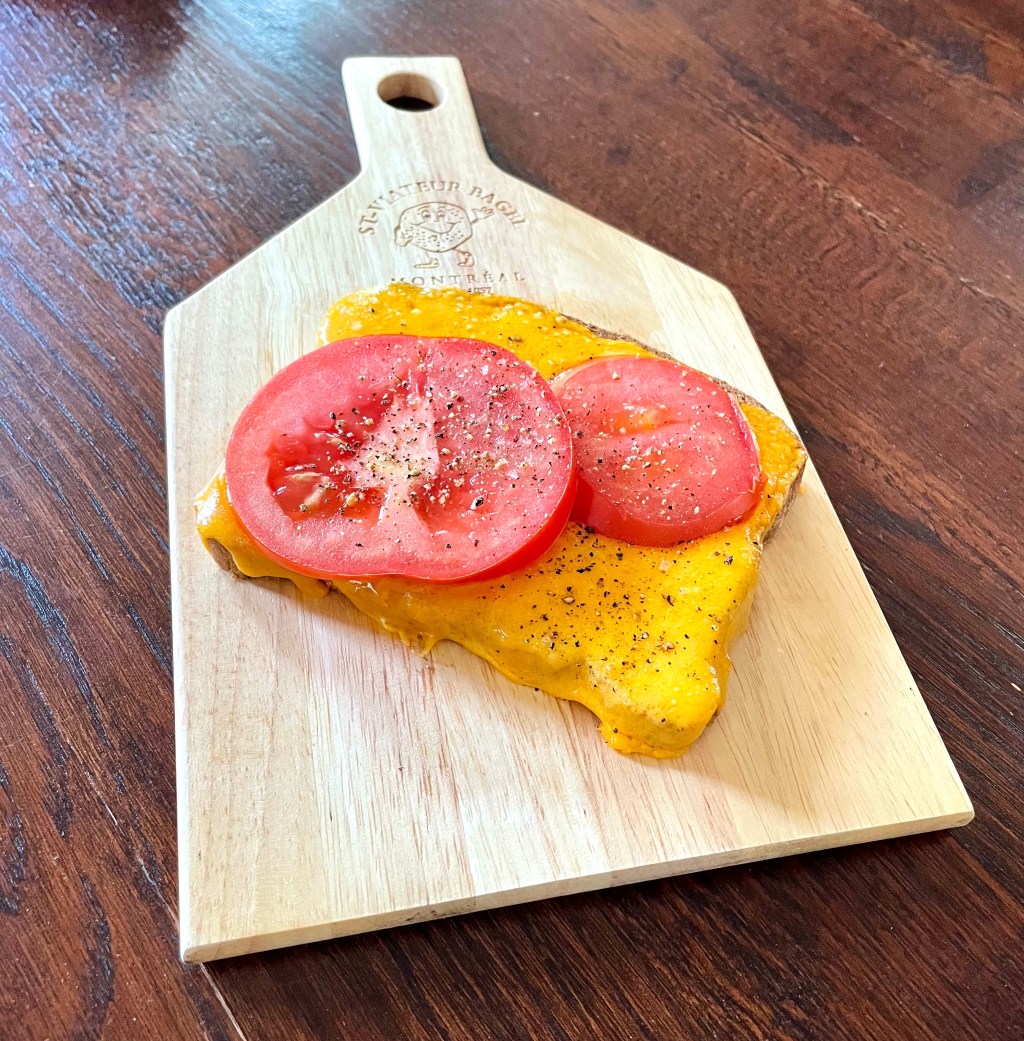
Essentially an open-faced grilled cheese sandwich with tomato and cracked pepper, the cheese dream is a simple comfort food that’s delicious, vegetarian, and super easy to make. On a personal note, I grew up eating this with my sister and cousins at our grandparents’ house, so it holds a special place in my heart.
Oh, and here’s what I’m proclaiming to be the cheese dream theme song (thanks, Hillary Duff).
What are dreams made of?
Melted cheese. And sometimes tomatoes.
Prep time: 2 mins
Cook time: 5 mins
Start-to-finish time: 7 mins
Complexity: 1/10 (slicing and broiling)
Budget: $1-$2 per toast, depending on what kind of cheese you buy
Occasion: Comfort food! An easy lunch or snack. Great for kids (especially picky eaters).
The Ingredients
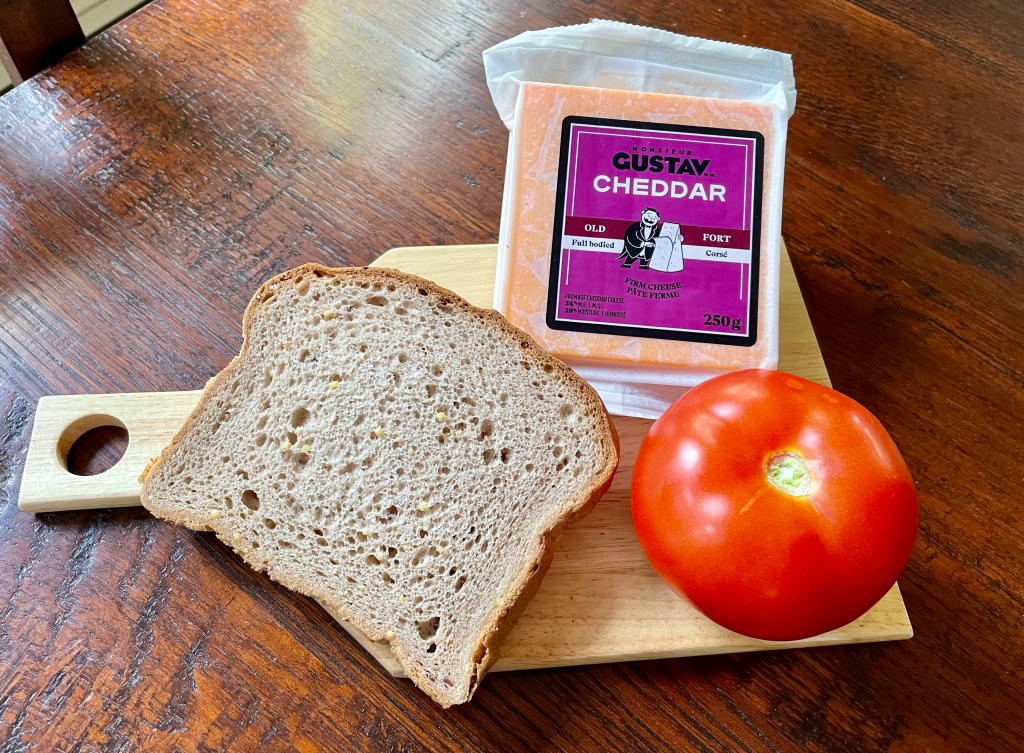
- One slice of bread (Little Northern Bakehouse Whole Grain Wide Slice pictured here)
- Your favourite cheddar cheese (old/sharp cheddar by Monsieur Gustav pictured here)
- A tomato (you won’t need the whole thing for a single toast)
- Salt and pepper to taste
- Optional: butter or margarine (not pictured)
The Steps
- Lightly toast your bread. This gives it structure so that it isn’t floppy after you melt the cheese overtop (don’t skip this step).
- While the bread is toasting, cut a few slices of cheese, enough to cover your bread in a single layer. Slices should be about ½ a centimetre thick.
- Cut 1-2 slices of tomato.
- After the bread has finished its initial toast, spread butter or margarine overtop (optional).
- Lay out the slices of cheese on your bread so they cover the surface in a single, even layer.
- Cook the bread and cheese together using one of the following methods:
- Broil in the oven or a toaster oven (450º F for 5 minutes in the toaster oven, 3-5 mins in the oven, closely watched)
- Butter the bottom of the bread and fry (cheese-side up) in a pan over medium heat. Cover the pan with a large pot lid to help the cheese melt. Cook until the cheese is melted and the bottom of the bread begins to brown.
- Pop the toast and cheese into the air fryer (450ºF for 5 mins)
- Halfway through the cooking time, add the tomato slices to the top of the cheese. Continue cooking the toast.
- Once cooked, finish with salt and freshly cracked pepper, to taste.
- Enjoy!!
The Extras
Simplify it
The Cheese: Use pre-sliced cheese to cut down even more on time. Fancy cheese is not required for this at all—many people use Kraft Singles to make their cheese dreams (much less expensive and melts quicker!)
The Tomato: Instead of adding the tomato slices halfway through the cooking process, you could place them on top of the melted cheese uncooked. If tomatoes aren’t your thing, you could leave them off altogether.
The Bread: This recipe can go on basically any kind of bread. To make it even simpler than it already is, grab a slice of white bread (or whatever bread you have in your pantry/freezer).
The Garnish: Salt and pepper are optional! Consider leaving them off or swapping them for something simple like garlic powder.
Scale it up
The Cheese: Be choosey with your cheese! Varieties like fresh buffalo mozzarella, applewood smoked cheddar, gouda, Swiss, feta, or parmesan would be great supports to those beautiful, bright tomato slices.
The Tomato: Instead of your classic beefsteak tomato, try other varieties like the Roma, cocktail, or cherry/grape tomatoes. Experiment with colours, flavours and sizes! Check out this list of different tomato varieties for more ideas.
The Bread: Make this on a slice of fresh sourdough or a sliced baguette to fancy-up your cheese dreams!
The Garnish: Consider adding red pepper flakes, fresh parsley, paprika and garlic powder, or your favourite steak spice to liven up the flavour. Finish with other herbs or spices if you switch up the cheese (e.g., pesto to go with mozzarella, za’atar if you use feta, etc.).
About the Ingredients
Cheddar Cheese
Whey back in the 12th Century, cheddar cheese was invented in the village of Cheddar in the county of Somerset, England. Legend has it that a milk maid forgot about a pail of milk overnight in the caves surrounding Cheddar. When she returned to collect it the next morning, it had solidified into (the beginning stages of) cheese. Of course that’s not how we make it today (thank goodness). But the cheese lore is pretty cool, regardless its accuracy.
So how is cheddar cheese made (if not forgotten by a milk maid in a cave)? Food historians believe that it was created as a way to preserve milk, which was highly perishable in an environment that completely lacked refrigeration. Cheese creators heat milk and add acid (usually rennet, which is a chemical from the intestines of cows, goats, or sheep, but citric acid or lemon juice also does the trick). The and heat acid cause the milk solids to clump together, creating curds, leaving behind liquid called whey. The curds are then extracted and “cheddared” (cheddar is actually a noun, a proper noun, AND a verb). This means that the curds are formed into squares and stacked on top of each other. The stacks are turned over and re-stacked every so often so that the remaining whey can drain out until the cheese has reached the creator’s desired moisture level (according to today’s standards for mass-produced cheddar cheese in the US, it’s no more than 50% moisture, but this varies according to age, manufacturer standards, and type). The curds then undergo a process called milling, wherein the curds are chopped and mixed together and salt is added to bring out the cheddariness. The milled curds are then gathered together and shaped, sealed, and aged. Traditionally, the dried curds were then wrapped in a layer of butter to seal it up so that the cheese could be kept and aged without spoiling. Once cotton became more widely available—read about the important and problematic history of the cotton industry here—producers started wrapping it in cotton cloth that was coated in lard or butter, which allowed a thick rind to form. Some manufacturers prefer to age and store the cheese in wax. Age is the primary difference between milder and sharper cheddars: milder cheddars are buttery, light, and smooth and are typically aged for 2-3 months, while extra sharp cheddars are tangy, salty, and crumbly, and are often aged for a year or more. Mild cheddars also have lower melting points than sharp cheeses.
Although originally an English invention (and extremely popular with the British Royals throughout history), the first cheese factory with standardized production of cheddar opened up in 1851 in upstate New York. They made use of Joseph Harding’s (AKA the father of cheddar cheese) innovations in cheddar making, which included a milk scalding process that made the texture of the curds smoother.
There is hardly any difference between white and orange cheddar cheese, aside from colour. White is the natural colour of cheddar (closest to the colour of milk), and the orange colour of orange cheddar comes from the natural dye called annatto, which comes from the tropical achiote tree. The achiote tree originates from Central and South America, Mexico, and the Caribbean, and the annatto seeds have been used for hundreds of years in Latin American food.
If you’re a turophile like me (translation: someone who likes cheese a lot), you might also like to check out these websites/Insta accounts:
- https://culturecheesemag.com/
- https://www.instagram.com/cheezytalkwithmadelyn/
- https://www.saveur.com/history-of-cheddar-cheese/
- The Oxford Companion to Cheese: https://books.google.ca/books?id=qRg1DQAAQBAJ&printsec=frontcover&redir_esc=y#v=onepage&q&f=false
Tomatoes
Today, there are over 10k varieties of tomatoes. But the first wild tomatoes grew in the Andes region of South America, around northern (modern) Peru and southern Ecuador. The indigenous peoples in that area harvested the fruit and it made its way north to Aztec regions in modern-day Mexico. The Aztec and Mayan populations were the first to domesticate tomatoes around 500BCE. The Aztec people called the fruit xitomatl, and the tomatillo miltomatl, reflecting their visual similarity and distant botanical relationship (although they’re not related enough to be substituted for each other in a meal… think plantain & banana level of relation). After (brutally) colonizing this area (learn more about this here and here), Hernán Cortés and his Spanish troops were likely responsible for bringing tomato seeds back to Spain, the fruit’s first touchdown in Europe. The word xitomatl (especially the “tomatl” part) was changed to tomate by the Spanish, bringing it close to its modern English name.
Interestingly, the fruit was widely rejected across Europe before it landed in Southern Italy in the mid-16th Century. There, it was incorporated into regional cuisine (for example, pizza as we know it today was invented in Naples about 200 years later, of which tomatoes were an essential component. Bear in mind, though, that pizza actually has much older roots in Ancient Greek, Egyptian, and Roman times). People in other parts of Europe falsely believed that tomatoes were poisonous, and reacted to the fruit with fear and rejection. It was even commonly referred to as “the poison apple”. While it’s true that the stems and roots of the tomato plant contain a neurotoxin called solanine (don’t eat tomato stems/roots…), the actual tomato fruit isn’t (and has never been) poisonous. The production of solanine is common amongst all nightshade fruits and vegetables and acts as an insecticide while the nightshade plants are growing. Potatoes are also a member of the nightshade family and when they turn green and/or sprout, they have more solanine in them, which is why people typically recommend that you don’t eat sprouted potatoes.
The idea that tomatoes were poisonous came from a false conclusion caused by a confounding variable. Upper-class people in Europe in the 1500s and later would often die after eating tomatoes, but it wasn’t the tomatoes that were the problem: plates at that time were maid out of an alloy of pewter and lead. The acid in tomatoes would cause the lead to seep out of the plates and into the food, causing people to die from lead poisoning, not the actual tomatoes.
The tomato was believed to be a relative of the eggplant by people in China and India, the latter of whose peoples especially embraced the fruit as a crucial part of many different regional cuisines. Turns out they were almost right: the tomato is very distantly related to the eggplant at the family level (although they’re from completely different genera).
Learn more about the history and spread of tomatoes here:
- https://www.britannica.com/plant/tomato
- https://www.uvm.edu/news/extension/history-tomatoes#:~:text=Tomato%20seeds%20were%20brought%20from,primarily%20as%20an%20ornamental%20plant.
- https://www.youtube.com/watch?v=AG9Oc6TxDXU
Table Salt
Salt has played an integral role in human history across the world from antiquity until present day. In addition to being an essential element of human nutrition, people have used salt as a natural preservative, a currency, in religious rites and rituals, as an antiseptic, in pharmacology, to enhance the flavour of food, in trade to build entire economies, and even in pottery from the Iron Age (just to name a few). It’s believed that salt was such a precious mineral that Ancient Roman soldiers used to receive it as part of their pay, leading to the term “salary”.
It’s said that people have been eating salt for as long as they’ve been eating vegetables. Since meat protein naturally stores a far higher concentration of salt than veggies do, people didn’t need to intentionally consume salt when their diets consisted primarily of animal meat. In places and times where diets shifted to more of a balance between meat and veggies (or consist(ed) entirely of vegetables), people started adding salt to their food as a nutritional supplement and flavour booster. For example, the word “salad” comes from the ancient Roman practice of salting vegetables before eating them, and the root of this word is salata, the ancient Latin word for “salted”.
Salt has been used pretty ubiquitously to preserve food across the globe and across time. For instance, anishnabekagriculture.ca lists salt curing as one of the traditional methods of preserving food by the Anishnabek Indigenous peoples of Canada. The salt draws the water out of the food to stop bacterial growth and prolong its life. Other, highly popularized examples of salt preserved foods include kimchi, sauerkraut, cured meats and fish (e.g. gravlax!), and some cheeses. The practice of preserving vegetables and herbs in salt is especially important in places like Canada where food grows very scarcely during the winter. From the culinary archives of the McCord Museum in Montreal, we learn that herbs and veggies were “…set aside during the growing season […], chopped into small pieces, put in an earthenware jar and then covered with coarse salt.” (Catherine Ferland, 2022). The result is perfectly preserved herbs and veggies that last throughout the long, cold Québecois winter and make the perfect garnish.
The table salt that we know and love today has flavourful, nutritional, and social significance. In many European and British households up until as late as the 18th Century, hosts apparently organized their dinner table seating plan around the position of the salt mill when they hosted guests for meals. The host and the people held in the highest esteem were seated near the head of the table, above the salt mill. People’s positions in the social hierarchy gradually decreased as they were sat further away from the salt mill. Those at the bottom of the table, below the salt mill, were considered to be of the least social consequence in that particular setting.
Salt for modern culinary use comes in a variety of shapes, sizes, chemical structures, and intended uses. The classic table salt is small and structurally very pure, with a uniform crystal size. It dissolves quickly and is typically used to improve food flavour both during and after cooking. Used for the same purpose, iodized salt is table salt with potassium iodine added in, intended as a preventative measure against iodine deficiency. This salt can sometimes be more metallic tasting (but it’s not very noticeable). Popcorn salt is a more finely-grained version of table salt. It’s got very small crystals that are perfect for last-minute seasoning and that cling better to food. Kosher salt is another popular variety. It has larger crystals that stick well to food and is great for salting meat before cooking. Its name comes from the practice of Koshering meat according to Jewish culinary laws. Sea salt comes in a variety of shapes, including flakes. It is less refined than table salt, and is harvested from the sea, so it retains some natural impurities (this means that it has other minerals within it), which lend it a unique flavour profile. This makes it excellent as a garnish or as a finishing salt. Another popular variety is fleur de sel, which is salt that is harvested from the surface of sea water as it evaporates. It’s traditionally from the coast of Brittany, France. It’s almost exclusively a finishing salt. Finally (although there’s lots more salt types to learn about), rock salt is often used in culinary practice but is not for human consumption due to how much longer it takes for these crystals to dissolve. For example, it’s used in traditional ice cream production, can be used to preserve meat, fish, and cheeses.
Here’s more information about different types of salt and their uses (culinary or otherwise!)
- https://www.thechefandthedish.com/post/12-types-of-salt-and-what-they-re-best-used-for
- https://www.helaspice.com/na/blog/14-types-of-salt-and-when-to-use-them/
What’s discussed here is an extremely brief history that focuses mostly on the human consumption of salt, but there’s lots more to say about its significance in various religious practices, in the development of trade routes and economy across the world, in the development of industry, and in pharmacology. Here are some really interesting resources if you’re interested in reading more about how salt has shaped human history and culture:
- https://time.com/3957460/a-brief-history-of-salt/
- https://www.britannica.com/science/salt/Occurrence
- https://saltassociation.co.uk/education/salt-history/early-history/
- https://selectsalt.com/halotherapy/the-history-of-salt/
- https://seasalt.com/salt-101/about-salt/history-of-salt
- https://www.salt.org.il/frame_econ.html
- https://bcfoodhistory.ca/preserving-canning-food-history/
Black Pepper
Pepper is one of the world’s oldest known spices. It’s native to the Southwestern coastal state of India that’s now known as Kerala (once referred to as the Malabar coast). As far back as 2000 BCE, there’s evidence of pepper being used in traditional Indian cooking from this region. It’s also been recorded that during this time, pepper was being used during the mummification process by the Ancient Egyptians. Today, garam masala recipes from the Kerala area typically include black pepper, which is not necessarily a common ingredient in other regional varieties of the spice blend.
The peppercorn is a berry that grows on a climbing vine that thrives in hot, tropical climates. There are three types of peppercorns that are typically used in cooking: the black peppercorn (the most common), the green peppercorn, and white pepper (typically ground rather than found whole). All three types are sourced from the same berry, and their colour depends on the time that they’re harvested and the way they’re processed.
- Black peppercorns are created by harvesting the berries when they’re ripe. They’re left to ferment and then dried in the sun. The drying process is what gives them their crackly, black appearance. Inside the black peppercorn is a white seed, which is why cracked black pepper often looks light. The black outer shell is called the pericarp.
- Green peppercorns are created by harvesting the berries when they’re fully developed but not quite ripe yet. They’re typically then preserved in acid and brine and stored in cans or jars for long periods of time. They have a fresh taste and are often eaten whole in sauces like Green Peppercorn Sauce for steak.
- White peppercorns are basically just the internal seed of the black peppercorn. To create them, producers take black peppercorns and run them under water for 7-9 days to soften the pericarp (the black outer layer). Then, they remove the pericarp through scrubbing, and wash and dry the internal seed, yielding the white peppercorn.
Due to its punchy flavour, ancient history, and perceived health benefits, pepper was an extremely sought after (and expensive) commodity throughout history. It motivated several colonial expeditions by many European countries and was a major player in the spice trade. It was often referred to by many as “black gold” because it was so valuable. Here are some interesting resources for learning about how the quest for pepper shaped historical economies, communities, and motivated colonial exploration:
- https://www.worldhistory.org/Pepper/
- https://www.britannica.com/money/spice-trade
- https://www.ipcnet.org/history-of-pepper/
- https://food52.com/blog/26669-black-pepper-history
Nowadays, the major producers and exporters of pepper are India, China, Vietnam, and Brazil.
 Put it on Toast!
Leave a comment