

Salty, sweet, and packed with Vitamin C, Iron, and Magnesium (thanks, spinach!), this toast makes an awesome vegetarian breakfast or lunch and comes together in the time it takes to toast your bread.
The Recipe
Prep time: 5 mins (at the most… all you have to do is slice up the cheese and apple, and heat up a small pan)
Cook time: 5-7 mins
Start-to-finish time: 10-20 minutes
Complexity: 2/10 (slicing and pan frying required, very small time commitment)
Budget: Using the proportions below, this toast (2 slices) costs about $8-$10 in total
Occasion: Breakfast, Lunch, could be easily adapted to a crostini hors-d’oeuvre as an appetizer
The ingredients
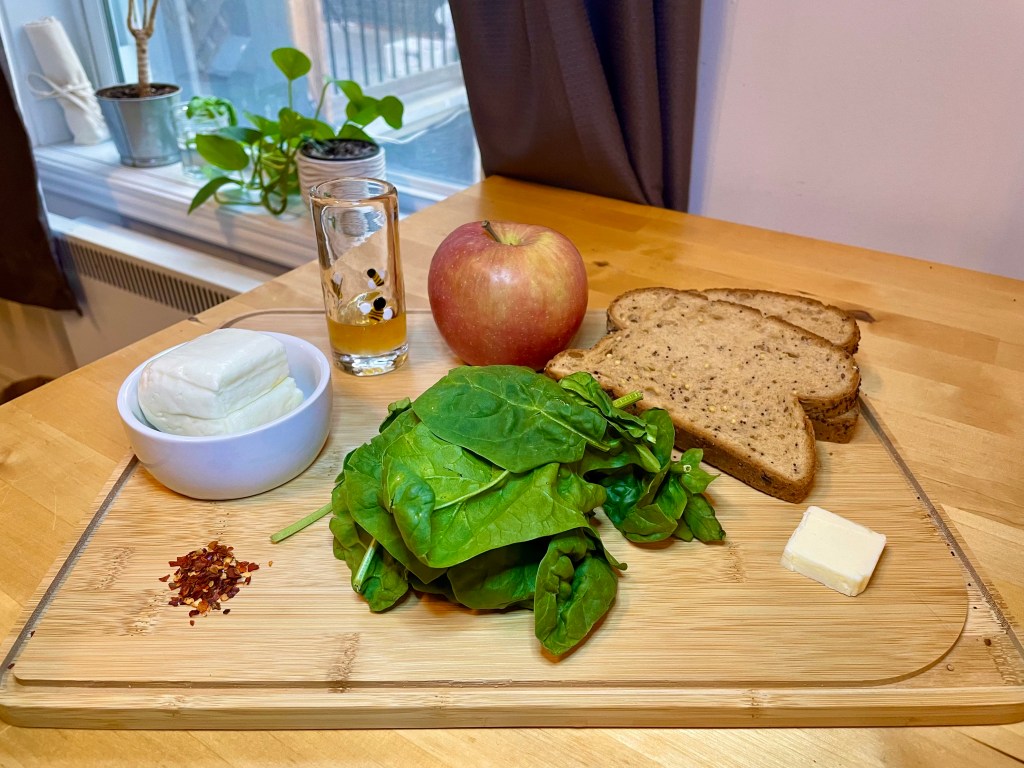
- One apple (Fuji apple pictured here)
- Folded halloumi cheese (~100g pictured here, adjust amount according to your personal preference and the number of toasts you’re making—I usually put 2-3 slices of halloumi on each toast)
- Handful of spinach
- ~1 tbsp Honey, for drizzling (adjust to personal taste)
- ~1 tsp chilli/red pepper flakes (adjust to personal taste)
- Bread, for toasting
- Softened butter (or margarine), for spreading on your toast
- ~1 tbsp olive oil, for frying
The steps
- Pre-heat the oil in a small non-stick frying pan over medium heat
- Cut the apple and cheese into ~1cm slices
- Put your bread in the toaster and turn it on. Toast to your preferred intensity. If you prefer well-toasted toast, make sure you begin the toasting process a few minutes before you start cooking the cheese. Ideally, your toast should pop up just before the cheese has finished cooking.
- When the oil begins to shimmer, add the cheese slices to the pan. Cook for 1-2 mins per side or until golden brown, flipping halfway through so that both sides become caramelized.
- When your toast has finished toasting, spread the butter/margarine on top and wait for it to melt. Then, arrange the spinach on the toast in a flat layer that’s 1-3 leaves thick. Place the apple slices on top of the spinach.
- Place the pan-fried halloumi slices on top of the apples. Sprinkle the red pepper flakes on top of the cheese and drizzle the honey over everything (to taste).
- Enjoy!!
The extras
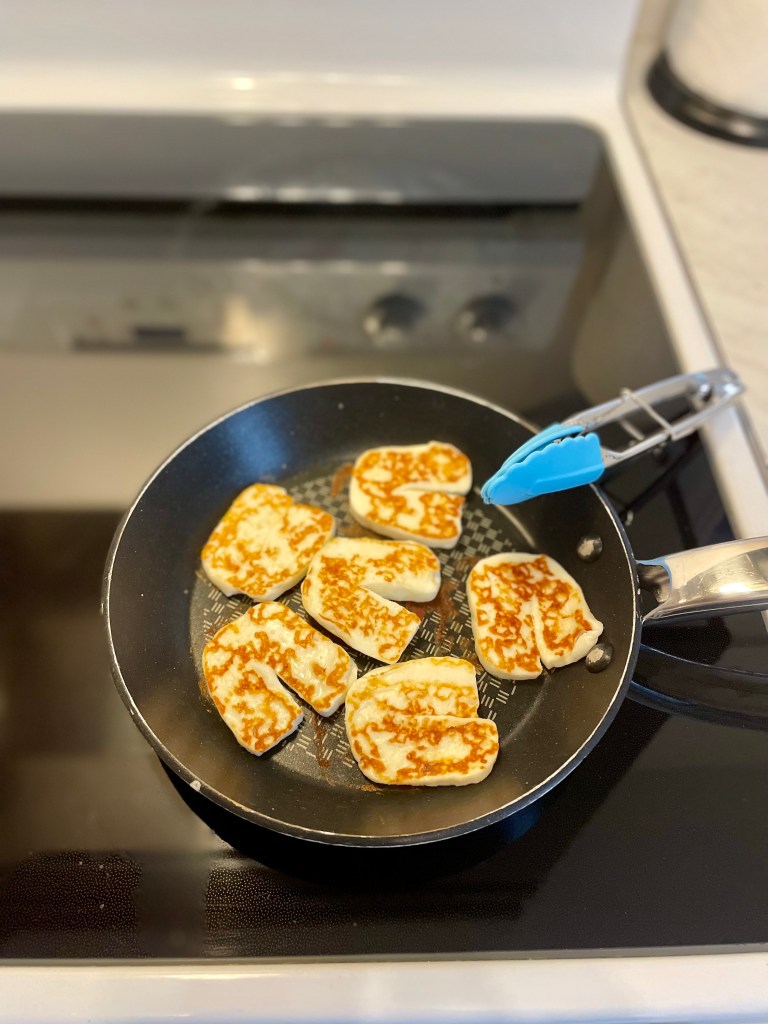
The lovely pan-fried halloumi cheese should look something like this when it’s ready to be added to your toast (it’s so beautiful):
Make it simpler
The Cheese: If you’re in a rush, replace the halloumi with cream cheese: spread about 2tsp on your toast and pile it up with the spinach and then the apples. This will save you both time and money!
The Greens: If you don’t have spinach on hand, you can use other leafy greens that might be hanging out in your fridge, like spring mix.
The Apples: In lieu of fresh apples, you could spread a layer of applesauce or apple butter on the toast before adding the spinach. This will save on cost and add more sweetness to the toast (you’ll probably want to add a little less honey at the end to keep things balanced).
The Garnishes: I wouldn’t recommend skipping out on the honey, unless you replace the halloumi with cream cheese (which is much less salty). The chilli flakes can be left off if you aren’t a fan and replaced with an herb like thyme or herbs de provence, or a garlic powder-based seasoning.
Scale it up
The Cheese: You can substitute the halloumi for any cheese with a high melting point. While the melting points of individual cheeses vary, those with relatively high melting points tend to hold their shape better when fried. Here are some examples:
- Paneer
- Queso frito
- Queso blanco
- Cheese curds
- Bread cheese (Finnish squeaky cheese)
- Feta (make sure you slice slice it thick enough to pan fry in olive oil and flip without it falling apart, ~2cm; don’t crumble it into the pan)
The Greens: Swap out the spinach for some kale (curly, baby, or black!). For the curly and black varieties, make sure you rinse the leaves twice, massaging them the second time to soften them.
The Apples: Try swapping out the apples for pears, nashi (apple-pears/Asian pears), quince, or guava slices.
The Garnishes: In addition to the honey and chilli flakes, try sprinkling on some pea shoots, alfalfa sprouts, or micro-greens.
The Base: This recipe could also be enjoyed on top of a fried, savoury potato pancake (rosti!) or as a bite-sized appetizer on some crackers.
About the ingredients
Halloumi
Halloumi (also known as haloumi, hellim, hallum, and calumi) is a semi-hard, brined cheese that originates from Cyprus and can be made from cow, sheep, or goat’s milk. It has a high melting point, so it’s perfect for grilling and frying because it won’t lose its shape, but is also delicious raw. It tastes very salty (thanks to the brine!), which is balanced by the caramelization that comes from cooking it. The texture is squeaky and crispy on the outside when grilled, baked, or fried. Halloumi is high in protein and calcium, and very low in carbohydrates.
Check out this site for more information on the history, types, and nutrition facts of halloumi!
Fuji Apples
This kind of apple was developed in Japan in the 1930s and named after the town Fujisaki, in which it was invented. This apple is crisp, juicy, and sweet (not quite as sweet as the Honeycrisp, but not as tart as the Granny Smith). The colour of each individual Fuji apple can vary widely: most typically, they have a yellow-green base with pink striping overtop. Their peak season is late fall and throughout the winter, and they’re known for their long shelf life (they can last up to 3 months!!).
This apple variety was actually borne out of crossing two American varieties: the Ralls-Genet (known by several other names) and the Red Delicious. The Ralls-Genet variety is very frequently used in apple breeding and was apparently grown by Thomas Jefferson at Monticello (read more about this apple variety here). The Red Delicious was originally discovered as a chance seedling in Iowa in the 1870s. A highly controversial variety today (Sarah Yager of the Atlantic clearly is not a fan), the Red Delicious was the most popular cultivated variety in the US from 1968-2018, when the Gala apple overtook it.
Here‘s a great resource for further reading about the Fuji apple variety.
Spinach
Leaf it to spinach to tell a great story. This veggie originally stems from historical Persia (now Iran) at least 2000 years ago. It arrived in China in the 6th Century CE, supposedly sent there as a gift from the king of Nepal. Its travels landed it in Spain in the 11th Century CE, brought there by tradespeople travelling through Northwest Africa. Its popularity there led it to be referred to as “the Spanish vegetable” by people in England. Spinach then travelled to Italy, where it was reportedly the favourite veggie of Catherine de Medici. When she married King Henry II of France, she brought her own cooks to France with her because they could prepare spinach exactly how she liked it (power move). This connection to Catherine de Medici is apparently why food that is served on a bed of (often wilted) spinach are called dishes à la Florentine (Catherine de Medici’s home was in Florence, Italy, hence the name). By the 19th Century, spinach was being regularly cultivated in North America, where it has been frequently associated with Popeye the buff cartoon character since 1929.
Spinach typically comes in three main varieties: those with smooth leaves, those with crinkly leaves, and those with leaves that are somewhere in between. It’s a cool-weather crop that’s supposed to be planted before the last frost of the winter season (tougher than it looks, I guess). Spinach with crinkly leaves lasts longer after it’s been harvested and contains less oxalic acid, which is said to interfere with the absorption/proper digestion of calcium and magnesium. Spinach is highly nutritious, full of iron, insoluble fibre, and tons of vitamins.
Here‘s a great resource for learning more about spinach.
Honey
Honey is ancient. According to this Natural Library of Medicine article, human uses of honey trace back over 8000 years. Stone age cave paintings (check out this one called The Man of Bicorp) show how ancient people have been collecting the sweet syrup for eons. Honey has a long history of being used for both culinary and traditional healing purposes. It has antibacterial properties, which were discovered in 1892 by a scientist named van Ketel and which have been extensively researched since them. Honey has also been used in both ancient and relatively recent history to heal wounds during wartime.
Honey comes in dozens of varieties. These varieties are usually named according to the type(s) of flower(s) pollinated in their cultivation and the methods used to prepare the finished product (e.g., filtration, whether or not it’s organic, any added products, etc.). Here’s a great site for learning about the different varieties of honey.
Honey is rich in antioxidants (with darker varieties offering more antioxidants than the lighter ones), is a great natural substitute for refined white sugar in cooking and baking, and can soothe a sore throat.
Chilli flakes
Also referred to as crushed red pepper/red pepper flakes, chilli flakes are made out of dried and crushed red chilli peppers. While the name is pretty generic, the blend of peppers included in your bottle of flakes may vary. Bon Appetite tells us that while jalapenos, bell peppers, fresno chillis, and Anaheim peppers are all common in red pepper flake bottles, cayenne pepper is by far the most common. Chilli flakes are made of almost the entire pepper, including the seeds, skin, and the veins. While many people believe that the seeds are the spiciest part of the pepper, it turns out that the pith (the fibrous white-ish bit in the middle that holds the seeds and creates the veins that run down the inside of the pepper) is actually the part of the pepper that has the highest concentration of capsaicin within it and is therefore the spiciest part of the vegetable. Learn more about peppers here.
Historically speaking, people have been harvesting red chilli peppers in Central and South America since around 7500 BCE. The story goes that Spanish explorers happened upon the red chilli while they were in Central and South America searching for black pepper. These explorers brought the chilis back to Europe with them and the peppers began travelling the world through trade. The small, ancient village of Bukovo, North Macedonia is supposedly the birthplace of crushed red pepper and many different brands of red pepper flakes are named after this place.
Butter
The spread of butter across the world was no accident. But its origins apparently are. In her book about butter, pastry chef and food writer Elaine Khosrova tells the story of how a herder in Africa around 8000 BCE was travelling with a container of milk strapped to one of his sheep. After a long journey of being jostled around by the sheep’s gait, the milk fats had solidified into butter.
There’s lots of story to tell here, so below are some recommended links for reading about the extremely interesting and lengthy history of butter. But in the meantime, here are some of the best butter stories I’ve found so far (most of these are sourced from The Butter Journal, which everybody should immediately go read):
Butter has had a huge impact on the economy of Europe throughout history. Butter was so central to the Irish economy at one point that they set up a butter exchange in Cork. There was so much butter to go around that they would make it in barrels and then age the barrel butter by burying it in a bog. Apparently ancient butter barrels are one of the most common archeological finds in Ireland today.
Mediterranean countries preferred to use cooking oils instead of butter, likely because their climates were not conducive to storing butter for long periods of time. European countries that were more to the north like the Scandinavias, however, were very active in the butter business. Apparently, butter was so important in Norway that in the middle ages, the king of the country required a whole barrel each year as a tax.
Butter continues to be the centre of some economic spheres. For example, Canada’s dairy lobby (colloquially known as the dairy cartel or Big Dairy in this Harvard International Review article) spends tens of millions of dollars each year to maintain certain relationships with parliament and strictly controls prices and production. A Calgary Herald Article reports that during Stephen Harper’s time as prime minister, import tariffs on non-domestic dairy products were between 202% (for skim milk) and 298% (for butter).
In France, butter was in such high demand that there was a need for some kind of replacement (manufacturing couldn’t keep up). So, Napoleon III (not the famous Napoleon, one of his nephews) put out a public call for someone to come up with a reasonable substitute. In 1869, scientist Hippolyte Mèges-Mouries came up with the first version of margarine, which he created by churning beef tallow with milk. This product was of course limited by the availability of beef tallow. What we know as margarine today (hydrogenized vegetable oil) was invented by a German scientist Wilhelm Normann in 1902.
Check out these sources if you want to read more about the history of butter:
 Put it on Toast!
Leave a comment